
GMP Internal Auditor Training in Canada
Every internal audit measures one thing against another. Get the second half wrong — or leave it undefined — and what comes out is opinion dressed as a finding.
GMP internal auditor training prepares manufacturing and quality staff to audit their own facility properly. It starts where the audit itself starts: deciding what is being examined, and what it is being examined against. Scope and criteria sound like paperwork. In practice they determine whether an audit finishes on time, whether its findings can be defended, and whether the area being audited accepts them.

What GMP Internal Auditor Training Covers
The course develops the ability to examine your own site against Good Manufacturing Practice requirements and the system the company has documented.
Both GMP and cGMP appear in course titles for this subject. GMP is the general term; cGMP adds the expectation that the system stays current with how the plant actually runs. The audit method is the same either way. Where a company also wants an independent body to assess the facility, GMP certification in Canada covers that route, and the article on how to get GMP certification in Canada explains the process.
Scope and Criteria Are Different Decisions
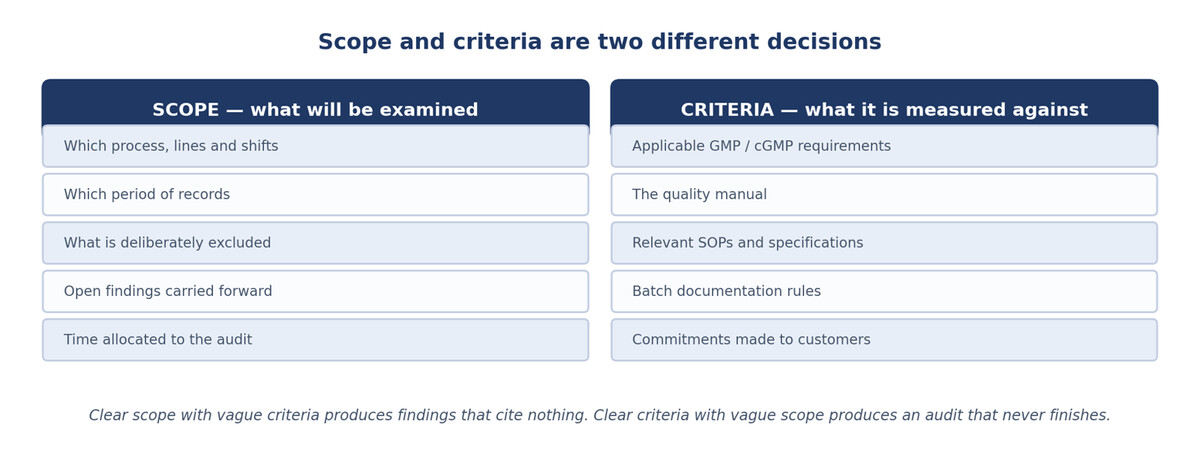
Scope answers what will be looked at: which process, which lines, which shifts, which period of records, and — just as importantly — what is deliberately excluded. Criteria answer what it will be measured against: the applicable GMP requirements, the quality manual, the relevant SOPs, batch documentation rules, and any commitments made to customers.
Confusing the two is the most common planning error. An audit with a clear scope and vague criteria produces observations nobody can act on, because there is no stated requirement to have fallen short of. An audit with clear criteria and vague scope never finishes, because there is no boundary telling the auditor when to stop.
Writing the exclusions down matters more than it sounds. “Packaging operations are outside this audit” prevents both the wasted hours and the awkward closing-meeting moment where an area is criticised for something nobody said would be examined.
What a Scope Statement Contains
| Element | Example |
|---|---|
| Process or area | Solid dose production, Lines 2 and 3 |
| Period of records | Batch records from the preceding quarter |
| Shifts or conditions | Day and afternoon shifts; night shift excluded this cycle |
| Criteria set | Applicable GMP requirements, Quality Manual s.4–7, SOP-PR series, customer specification C-114 |
| Explicit exclusions | Packaging, warehouse receipt, laboratory testing |
| Carried-forward items | Two open corrective actions from the previous audit |
| Time allocated | One day including preparation and drafting |
An area receiving this in advance knows exactly what to make available. An auditor holding it knows when the audit is finished.
Common Scoping Mistakes
| Mistake | What happens | Better approach |
|---|---|---|
| Scope too wide | Everything is touched, nothing is examined | Narrow to what can be tested properly in the time |
| Criteria left as “GMP” | Findings cannot cite a requirement | Name the specific documents and clauses |
| No period stated | Auditor reviews whatever is nearest to hand | State the period and sample across it |
| Exclusions unstated | Areas feel ambushed; disputes at closing | Write exclusions into the plan and the report |
| Open actions ignored | Last year’s problems are never revisited | Carry unresolved items into scope explicitly |
| Scope changed mid-audit | Planned areas go unexamined | Note the new issue, report it, audit it later |
How the Audit Proceeds From There
With scope and criteria fixed, preparation follows: reading the relevant procedures, the last report and the open corrective actions, then drafting a checklist that names sources and samples. A short opening meeting confirms the boundaries with the area so nobody is surprised.
The audit itself alternates between three sources — the procedure, the activity as it happens, and the records that should describe it — with referenced notes taken throughout. Where an exception appears, the sample widens immediately.
Findings are written and graded ahead of the closing meeting, each stating the requirement, the evidence and the shortfall. The report records what was in scope, what was excluded, what criteria applied, what was sampled, and what was found. Afterwards the corrective action is reviewed and its effectiveness verified against evidence rather than a closure signature.
An Annotated Scope Statement
A scope statement is short — usually half a page — and every line in it is doing work. Reading one line by line makes the point better than describing it.
“This audit covers solid dose production, Lines 2 and 3, during day and afternoon shifts.” Three decisions: the process, which lines, and which shifts. Night shift is excluded, which will be stated explicitly rather than left implied.
“Records reviewed will cover the preceding quarter.” The period bounds the sample and tells the area which files to have available. Without it, the auditor reviews whatever is nearest.
“Criteria: applicable GMP requirements, Quality Manual sections 4 to 7, the SOP-PR series, and customer specification C-114.” Now every finding can cite something. This is the line most often written as “GMP” and most often regretted.
“Excluded: packaging operations, warehouse receipt, laboratory testing.” Three areas the report will not speak to. Stating them protects the auditor from scope creep and protects the area from being read as having passed something nobody examined.
“Carried forward: corrective actions CA-2024-11 and CA-2024-19 remain open from the previous audit and will be verified.” Unresolved items get examined rather than forgotten.
“Duration: one day, including preparation and report drafting.” An honest time budget, which is what keeps the scope realistic.
Seven lines. An area receiving this knows exactly what to prepare; an auditor holding it knows when the audit is complete; and a reader six months later can interpret the report correctly. The absence of any one line creates a specific, predictable problem — which is why the training treats the scope statement as a deliverable rather than a formality.
Who Should Attend GMP Internal Auditor Training
| Participant | What scoping skill gives them |
|---|---|
| QA managers and officers | Audit plans that fit the calendar and still test something |
| Quality system owners | An audit programme built from defensible scopes |
| Production supervisors | Clarity on what will and will not be examined |
| QC and laboratory staff | Criteria that reference methods rather than generic requirements |
| Engineering and validation | Scopes that capture calibration and change control properly |
| Warehouse and materials teams | Traceability scoped end to end instead of in fragments |
| Compliance and regulatory staff | Translation of requirements into a usable criteria set |
| Contract manufacturers | The ability to scope supplier audits with limited access |
No previous audit experience is assumed. Employees already inside a GMP system scope more realistically because they know how long things take. Anyone approaching manufacturing quality from outside the sector tends to begin with a cGMP foundation course.

Skills Developed
- Separating scope from criteria and writing both explicitly
- Assembling a criteria set from requirements, procedures and customer commitments
- Stating exclusions so expectations are set before the audit
- Sizing scope to the hours genuinely available
- Carrying unresolved findings from previous cycles into the current scope
- Resisting scope creep without ignoring what turns up
- Sampling records across a stated period
- Recording referenced evidence throughout the audit
- Wording findings that cite the criteria they fell short of
- Reporting scope and exclusions so readers know what the audit did not cover
Why It Matters Commercially
Canadian manufacturers supplying export customers and multinational buyers face repeated second-party audits. Those auditors arrive with their own scope, and a site accustomed to being audited against defined criteria handles them far more calmly than one that has only ever done informal walk-arounds.
There is an internal benefit as well. Audit programmes collapse most often because audits overrun, get postponed, and eventually stop happening. Realistic scoping is the single most effective defence against that.
Training Versus Certification
| GMP internal auditor training | GMP certification | |
|---|---|---|
| Directed at | Individual employees | The company and its facility |
| Conducted by | Your own trained staff | An independent certification body |
| Yields | Auditing competence and a training record | A certificate covering a defined scope |
| Repeats as | Audits scheduled through the programme | Surveillance and recertification |
A certified system is expected to audit itself, so the two support each other — but training certifies nobody, and a certificate does not audit anything.
GMP Internal Auditor Training in Canada: Course Details
The duration of GMP internal auditor training in Canada depends on the delivery route chosen, and fees are quoted alongside it rather than separately. A certificate of completion listing the topics covered goes to each participant who finishes, and assessors ask for it when checking auditor competence.
The GMP internal audit course also covers report writing, so each finding cites its criteria and stands up to challenge. Tracing a recurring problem to its root cause, without naming an individual, is part of it.
Objective, coverage and outcomes
Objective. Prepare participants to scope, plan, conduct, report and follow up internal audits of GMP and cGMP quality systems.
Coverage. GMP and cGMP fundamentals; defining scope and exclusions; assembling criteria; audit planning and checklists; sampling; observation and interviewing; objective evidence; nonconformity classification; findings and reporting; corrective-action review and verification; auditor independence.
Outcomes. Participants should be able to write a defensible scope statement and criteria set, conduct the audit, record referenced evidence, raise nonconformities, produce a report and evaluate corrective actions.
Delivery formats
Classroom sessions, live virtual sessions, self-paced study and on-site delivery. Scoping is best practised against a company’s own processes, which in-house delivery permits; otherwise online cGMP internal auditor training and virtual cGMP training cover the same ground, with the syllabus on the IAS GMP internal auditor training page. Upcoming dates are listed on the IAS Canada training schedule.
Send your site location, product categories and participant numbers and we will propose a format and dates.
To be exact about the offering: IAS provides training and certifies management systems. Facility licensing and product approval rest with regulators alone.
Ready to book, or want in-house dates? Contact IAS Canada.
Frequently Asked Questions
What is the difference between audit scope and audit criteria?
Scope is what will be examined — which process, lines, shifts and period of records, plus what is excluded. Criteria are what it is measured against — applicable GMP requirements, the quality manual, relevant SOPs and customer commitments. Scope tells the auditor when to stop; criteria tell them what counts as a shortfall.
Why write exclusions down?
Because unstated exclusions cause disputes. If packaging was never going to be examined, the plan should say so. That stops the area assuming it passed, and it stops the auditor being drawn into it. It also stops anyone later reading the report as a clean bill of health for something that was never looked at.
How wide should a single audit be?
Narrow enough that everything in scope can be tested properly within the time allocated, including preparation and drafting. Auditors consistently over-scope on their first few audits. A focused audit that examines one process thoroughly is worth more than a tour of six.
Can criteria just be stated as “GMP requirements”?
Not usefully. A finding has to cite something specific, and “GMP” is not specific enough for anyone to act on or dispute fairly. Criteria should name the documents and, where practical, the clauses — the quality manual sections, the SOP series, the customer specification.
What happens if something significant appears outside the scope?
Record it, raise it with the area straight away if it presents real risk, note it in the report as an observation outside scope, and schedule an audit that covers it properly. Abandoning the current scope to chase it usually means the planned areas never get examined.
Should previous open findings be inside the new scope?
Yes, explicitly. Verifying that last cycle’s corrective actions actually held is one of the highest-value things an audit does, and it will not happen unless it is written into the scope. Findings that recur year after year are almost always ones nobody re-examined.
Who agrees the scope — the auditor or the area?
The auditor sets it, working from the audit programme and previous findings; the area is informed rather than consulted on what will be examined. Timing and availability are genuinely collaborative. Letting the area negotiate scope undermines the independence that makes the audit worth running.
How does scope work for a supplier audit?
More tightly, because access and time are limited. A second-party scope typically names the processes relevant to your product, the period, and the criteria drawn from your supply agreement as well as GMP. Being explicit matters even more here, since the supplier is giving up production time to host you.
Does the report need to repeat the scope?
It does. A reader six months later has no other way of knowing what the audit covered. A report stating scope, exclusions, criteria and what was sampled can be interpreted correctly; one that lists only findings invites the assumption that everything else was checked and found satisfactory.