
GMP and cGMP Certification in Canada
Independent third-party GMP and cGMP certification for manufacturers operating in Canada — scoped to your products, audited against the applicable scheme, and backed by a fixed written quotation. Whether you sell domestically, into the US, or further afield, IAS scopes the audit to fit.
Ready to scope your certification? Share your facility details and product categories for a fixed written quotation — contact IAS Canada today.
At a Glance
- Scope: your product category decides the scheme, and the scheme decides the audit — there is no universal cGMP checklist.
- Eligible industries: pharmaceuticals, food, natural health products, cosmetics, cannabis, medical devices, and any other manufactured product category.
- Certification cycle: application and scoping, documentation review, Stage 1 and Stage 2 audit, certificate, surveillance, recertification.
- Pricing: a single written quotation once scope is settled; nothing is published as a flat rate and nothing is added later.
- Accreditation: IAS’s certification activity sits under its UQAS accreditation.

Manufacturing Without Borders: Two Sets of Expectations
Canada’s manufacturing base is unusually intertwined with the United States, and easy cross-border movement is not the same as scrutiny-free.
- US-side buyers — retail chains, distributors and pharmacy networks used to FDA-regulated suppliers ask hard questions about manufacturing controls before signing a purchase order.
- Domestic obligations — Health Canada licenses and inspects establishments handling drugs and many natural health products, maintaining its own GMP guidelines aligned with the PIC/S GMP guide (Canada is a PIC/S participating authority).
- Food specifically — the Canadian Food Inspection Agency (CFIA) administers federal licensing and oversight under the Safe Food for Canadians Regulations.
Independent certification gives both audiences a shared, third-party reference point — one credential that speaks to quality-system maturity regardless of which side of the border is asking. If you are weighing the FDA certification in Canada route, the practical comparison is with how to get GMP certification in Canada rather than with your existing licence.
Who Regulates What in Canada’s GMP Landscape
Health Canada licenses and inspects establishments within its own remit. The US FDA does the same, but only for the US market. WHO publishes guidance and neither regulates nor certifies anyone. IAS is the independent body that issues third-party certification.
| Body | Role | Category |
|---|---|---|
| Health Canada | Licenses drug establishments (Drug Establishment Licence) and many NHP sites; issues and enforces its own GMP guidelines (PIC/S-aligned); conducts its own compliance inspections | Domestic regulator, drugs/NHPs |
| Canadian Food Inspection Agency (CFIA) | Administers federal food licensing and safety oversight under the Safe Food for Canadians Regulations; inspects food establishments within its jurisdiction | Domestic regulator, food |
| World Health Organization (WHO) | Publishes GMP guidance and model quality-system texts used as a reference framework worldwide | Standard-setter only — not a regulator or certifier |
| US Food and Drug Administration (FDA) | Regulates and inspects establishments supplying the US market only; issues no third-party certificates and has no authority over Canadian domestic licensing | Foreign regulator, US-market only |
| IAS (Integrated Assessment Services) | Conducts independent third-party audits and issues GMP/cGMP certification against the scheme and scope declared at application, under its UQAS accreditation | Independent certification body |
An IAS certificate is not Health Canada or CFIA approval and is never presented, marketed or implied as such. It is not US FDA approval, clearance or listing — no certification body can grant that. And it is not a substitute for any licence: certification runs alongside regulatory obligations rather than replacing any of them.
Not sure which scheme applies to your products? Ask IAS Canada for a free scoping conversation.
cGMP Meaning in Canada: GMP vs cGMP, and What “Current” Adds
“cGMP” adds the word current to GMP. It signals that a manufacturer’s practices reflect the latest applicable standards and technology rather than a fixed, one-time checklist. Neither term names a single certifiable international standard.
- Both are umbrella descriptions of good-manufacturing-practice discipline. The specific requirements always come from whichever scheme applies to a given product and market — Health Canada’s guidelines, WHO GMP, the PIC/S GMP guide, US FDA 21 CFR for US-bound goods, ISO 22716 for cosmetics, and others.
- GMP is the broader label for manufacturing-quality discipline generally.
- cGMP emphasizes that a facility’s controls, equipment and documentation practices are kept current as guidance, technology and risk understanding evolve.
- Neither term corresponds to one universal certifiable standard; the applicable scheme and scope are always identified and stated on the certificate itself.
| Aspect | GMP | cGMP |
|---|---|---|
| Emphasis | General adherence to manufacturing quality practices | Ongoing currency of those practices against the latest applicable guidance |
| Typical use in Canada | Used loosely to describe manufacturing-quality controls generally | Often used when comparing Canadian practice against US FDA cGMP expectations for export |
| Certification basis | Assessed against a named scheme and declared scope | Assessed against the same kind of named scheme and scope — “cGMP” is not a separate certifiable framework |
No Single Rulebook: How Requirements Shift by Product Line
Food, pharmaceuticals, natural health products, cosmetics and medical devices manufactured in Canada do not share one identical GMP framework. The applicable one — or combination — is confirmed at scoping, not assumed in advance.
| Product category | Commonly referenced framework(s) |
|---|---|
| Pharmaceuticals | Health Canada GMP Guidelines (PIC/S-aligned); WHO GMP; US FDA 21 CFR for US-bound product |
| Food and beverage | CFIA licensing requirements; WHO GMP food-hygiene references; HACCP-aligned controls |
| Natural health products (NHPs) | Health Canada NHP-specific GMP requirements; WHO GMP as a general reference |
| Cosmetics | ISO 22716 as the commonly referenced cosmetics GMP framework |
| Medical devices | Quality-system frameworks referenced alongside device-specific regulatory pathways, distinct from pharmaceutical GMP |
| Cannabis products | Health Canada’s cannabis-specific GMP-aligned requirements, assessed independently of pharmaceutical or food schemes |
| Other industries (packaging, chemicals, feed, warehousing) | Scoped to a scheme and set of controls appropriate to that specific product and process — no single default applies |
Food-line manufacturers frequently pair this with HACCP certification or ISO 22000 certification, and device manufacturers with ISO 13485 certification, as complementary schemes.
Food, pharmaceuticals, cosmetics and medical devices are not the only eligible sectors. Any manufacturer, packager or processor — including businesses in packaging, chemicals, animal feed or contract warehousing — can pursue certification scoped to its own products and processes.
Inside a GMP Audit: What Assessors Typically Review
The specific checklist depends on the scheme and scope agreed at application, but several themes recur across most Canadian facilities regardless of product category — areas typically assessed, not a universal fixed list.
- Facility layout, environmental controls and contamination-prevention measures appropriate to the product line
- Equipment qualification, calibration records and preventive maintenance practices
- Quality management documentation — quality manual, standard operating procedures and change-control records, as applicable to the scheme
- Batch or production records and traceability practices, where relevant to the product category
- Corrective and preventive action (CAPA) handling and root-cause investigation practices
- Personnel training records and hygiene or gowning practices suited to the manufacturing environment
- Data integrity controls across paper and electronic recordkeeping systems, where applicable
- Supplier and incoming-material controls relevant to the certified scope
Keeping those areas audit-ready between assessments is what a site’s own internal audit programme is for; GMP internal auditor training in Canada covers the method.
The Paper Trail: Documentation Typically Reviewed
Exactly which records an assessor asks for depends on the scheme and product category agreed at scoping — not a universally mandatory checklist for every applicant:
- Quality manual — the overarching description of how the facility’s quality management system operates, where a scheme calls for one.
- Standard operating procedures (SOPs) — documented, repeatable instructions for manufacturing, cleaning and quality-control activities relevant to the certified scope.
- Change control records — evidence that changes to processes, equipment or formulations are evaluated and approved before implementation.
- CAPA logs — documentation showing how deviations and nonconformities are investigated and resolved.
- Validation and qualification records — evidence that equipment, processes or methods perform as intended, where validation applies.
- Batch or production records — traceable records tied to specific production runs, where relevant to the manufacturing process.
- Data integrity controls — safeguards over both paper and electronic records that support the reliability of the documentation above.
A facility does not need every item on this list to start the conversation. Gaps found during documentation review carry into the audit plan and, where needed, are closed through corrective action before any certification decision.

Earning Your Certificate: The IAS Pathway
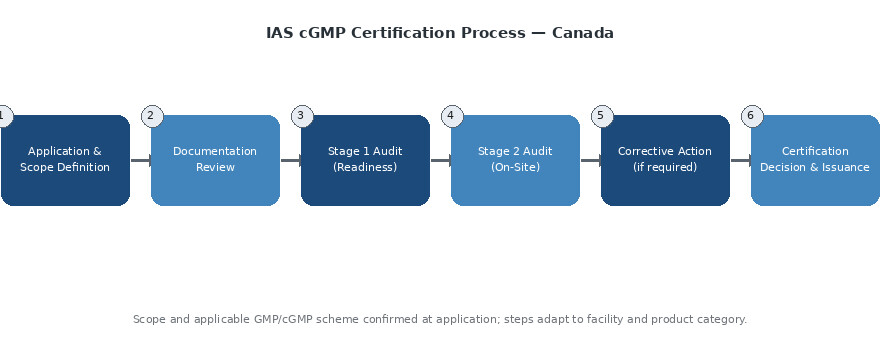
- Application and scope definition — the manufacturer and IAS agree on the applicable GMP/cGMP scheme, product category and site(s) to be assessed.
- Documentation review — quality manual, SOPs and related records relevant to the declared scope are reviewed for completeness.
- Stage 1 audit — an assessor evaluates the facility’s readiness and identifies any gaps before the full on-site assessment.
- Stage 2 audit — an on-site assessment examines implementation of the quality system against the applicable scheme.
- Corrective action, where required — any nonconformities identified are addressed with evidence before a certification decision is made.
- Certification decision and issuance — once requirements are satisfied, IAS issues the certificate stating the applicable scheme and scope.
The certification process in Canada explains how IAS structures assessments generally.
Certificate Validity and Staying Certified
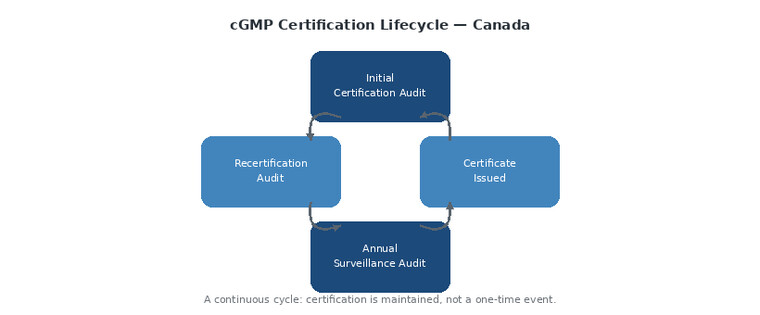
Certification is not a one-time event. After the certificate is issued, IAS conducts periodic surveillance audits confirming the quality system continues to operate as assessed. A recertification audit at the end of the cycle then renews the certificate.
- Facility readiness — how mature existing SOPs, CAPA processes and records already are shapes how much each stage involves.
- Scope breadth — the number of product lines and how many sites are included both influence timelines rather than a fixed schedule.
What Shapes Cost and Timeline for a Canadian Facility
GMP certification cost in Canada is quoted per site. IAS does not publish a standard price or a fixed number of weeks, because both depend on facility-specific factors. Every engagement is confirmed with a fixed, written quotation before work begins, so there are no open-ended fees.
| Cost / timeline driver | Why it matters |
|---|---|
| Number of sites in scope | A single-province operation versus facilities spread across multiple provinces changes the audit plan and total audit time |
| Product category complexity | A pharmaceutical or NHP line typically involves more documentation depth than a simpler packaged-goods operation |
| Facility readiness | How mature existing SOPs, CAPA processes and records already are affects how much preparation precedes the audit |
| Existing regulatory standing | A facility already operating under a Health Canada licence or CFIA registration may have more of the underlying documentation in place |
| Scope breadth | Certifying multiple product families under one roof takes longer than a single, narrowly defined product line |
Want a real number, not a range? Request your fixed written quotation.
From Domestic Shelves to Export Crates: Who Applies
Beyond the pharmaceutical and food manufacturers most often associated with GMP, a wide range of Canadian businesses pursue certification once they start selling into markets or to buyers who expect it:
- Pharmaceutical and biologics manufacturers supplying both domestic and export markets
- Food and beverage processors, including private-label and co-packing operations
- Natural health product and supplement manufacturers
- Cosmetics and personal-care product formulators and fillers
- Licensed cannabis producers scoping certification to their own product lines
- Contract manufacturers and packagers producing on behalf of multiple brand owners
- Packaging, ingredient-supply and warehousing operations supporting regulated supply chains
Export Destination Shapes the Conversation
Because export destination shapes buyer expectations as much as product category does, the table below sketches how the certification conversation tends to differ depending on where the product is headed.
| Export / sales destination | What it tends to mean for certification |
|---|---|
| United States | Buyers and distributors often benchmark suppliers against US FDA-adjacent expectations regardless of formal certification status |
| European Union | Buyers frequently expect documented alignment with internationally recognized GMP principles alongside any product-specific EU requirements |
| Asia-Pacific markets | Import partners and distributors often request third-party certification as part of their own supplier due diligence, given limited ability to audit foreign facilities directly |
| Domestic Canadian retail and healthcare procurement | Large retail chains and institutional buyers increasingly request independent certification as one input into vendor qualification, alongside applicable Health Canada or CFIA registration |
See where your products fit? Get a free consultation — no obligation.
Working With IAS in Canada
- UQAS accreditation — IAS provides certification services under its UQAS accreditation, with assessment experience spanning nearly two decades across manufacturing sectors.
- Scoped engagements — Canadian manufacturers work with assessors who scope each engagement to the applicable GMP/cGMP scheme and product category.
- Transparent economics — a fixed written quotation is provided before work begins, with no open-ended fees.
- An ongoing relationship — IAS supports the surveillance and recertification cycle rather than treating certification as a single transaction.
A manufacturer weighing certification alongside existing Health Canada or CFIA standing is rarely asking a legal question. The practical one is about audience: who needs to trust your quality system without inspecting your facility themselves? A domestic buyer with its own technical team may be satisfied by your regulatory licence alone. A cross-border distributor, an overseas import partner or a retail chain building a new supplier list often is not. An independently issued certificate naming a clearly defined scheme and scope is what lets those relationships move forward without a facility visit of their own.
Where Canadian Applicants Most Often Stall
A handful of gaps come up repeatedly during Canadian assessments, and knowing about them ahead of time shortens the path to certification:
- Undefined scope — applying before deciding which scheme, product lines and sites are actually meant to be certified, which then has to be resolved before an audit plan can be finalized.
- Documentation that exists but is not controlled — SOPs and records are in use day to day but are not version-controlled or consistently followed, which surfaces quickly during a Stage 1 review.
- Multi-site inconsistency — a company with more than one Canadian facility applies practices unevenly across sites, complicating a certificate meant to cover all of them.
- Treating the regulatory licence as sufficient — assuming an existing Health Canada or CFIA licence already demonstrates everything a certification audit will look for. The two serve different purposes and are assessed differently.
Quick Definitions
- GMP: Good Manufacturing Practice — the umbrella term for manufacturing quality requirements.
- cGMP: Current Good Manufacturing Practice — the same discipline, with an explicit “stay current” emphasis, often invoked when comparing Canadian practice against US FDA expectations.
- Scheme and scope: the named framework and the products it covers, agreed before the audit is planned.
- Stage 1 / Stage 2 audit: a readiness review followed by the full on-site assessment against the applicable scheme.
- Surveillance audit: a periodic check confirming the certified system continues to operate as assessed.
- Recertification: the audit at the end of a certificate’s validity cycle that renews it.
The Next Step Toward Certification in Canada
Your facility may be preparing its first GMP audit, or adding certification alongside an existing Health Canada licence or CFIA registration. In either case, IAS can confirm the applicable scheme, scope and next steps for your specific product category.
- No obligation to proceed after scoping
- Written quotation covers the full cycle, surveillance included
- Scope confirmed for your specific product category and site(s) before any commitment
Related reading: the ISO certification in Canada hub covers the wider IAS Canada range, and the blog explains GMP certification online.
Ready to move forward? Ask IAS Canada for a fixed, written quotation scoped to your facility.
Frequently Asked Questions
Does any Canadian law require a manufacturer to hold cGMP certification?
No single law requires an IAS certificate. Health Canada licensing, CFIA registration and provincial requirements govern legal market access; certification is a voluntary, third-party assurance layer that many manufacturers pursue to satisfy customers, retailers and cross-border buyers.
Does an IAS certificate substitute for, or count as, Health Canada or CFIA approval?
No. An IAS certificate is independent, third-party recognition of a facility’s quality management practices under a defined scheme and scope. It never replaces a Health Canada Drug Establishment Licence, a CFIA licence or any other regulatory authorization, and it is never presented as such.
Our facility already meets Health Canada’s GMP guidelines — what does IAS certification add?
Regulatory compliance and third-party certification serve different audiences. Certification gives commercial partners, export customers and buyers who cannot conduct their own facility audits an independently verified, easily referenced credential alongside your existing regulatory standing.
How does certification support a Canadian manufacturer exporting into the United States?
Selling into the United States does not remove a US buyer’s own quality expectations. A certificate gives American purchasers, distributors and retail chains an independent reference point for a Canadian supplier’s manufacturing controls, which can shorten their own supplier-qualification review.
Does certification cover Canada’s licensed cannabis producers and natural health product manufacturers?
Yes. Cannabis producers and natural health product (NHP) manufacturers can pursue certification scoped to their own product category, in addition to any Health Canada licensing they already hold for those sectors.
Does a single certificate cover a Canadian company’s facilities in more than one province?
Certification is issued per assessed site. A company with production facilities in more than one province typically needs each physical location assessed and included in the certificate scope, rather than assuming coverage extends automatically between sites.
What happens if Health Canada revises its GMP guidance after a facility has been certified?
Certification is maintained through periodic surveillance, and manufacturers are expected to keep their quality systems current with applicable regulatory guidance between audits. Significant regulatory changes are typically reviewed at the next surveillance or recertification audit.
Does a GMP audit in Canada look at bilingual (English/French) labeling and documentation?
Where bilingual labeling or documentation is applicable to a facility’s product category and market, an auditor may review how that requirement is controlled as part of the broader quality system, though it is not itself a certification requirement.