
Are You Ready for ISO 14001:2026 – The Environmental Shift No One Can Ignore?
Sustainability is no longer a long-term ambition—it is becoming an immediate operational requirement. With the arrival of ISO 14001:2026, organizations are expected to move beyond traditional environmental practices and adopt systems that are real-time, data-driven, and continuously improving.
In Canada, where environmental responsibility and regulatory expectations are already strong, this shift raises the bar even higher. Businesses are no longer evaluated only on compliance—they are judged on how effectively they measure, manage, and improve their environmental impact.
ISO 14001:2026 is not just an update. It is a transformation that integrates sustainability directly into decision-making, operations, and long-term strategy.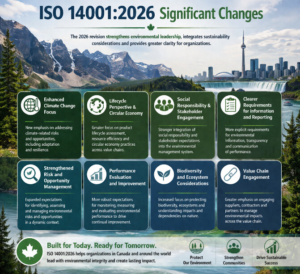
Why ISO 14001:2026 Is Creating Urgency?
The urgency surrounding ISO 14001:2026 is driven by environmental risks, evolving regulations, and increasing stakeholder expectations. Organizations must now demonstrate sustainability with clear data, measurable outcomes, and continuous performance visibility.
The Biggest Shift: From Compliance to Intelligence
One of the most significant changes is the transition from traditional compliance systems to intelligent environmental management. Businesses are expected to move beyond periodic audits and adopt real-time, predictive approaches.
- Continuous monitoring replaces delayed reporting – Organizations must track environmental performance in real time instead of relying on periodic audits.
- Predictive risk management becomes essential – Businesses are expected to anticipate environmental risks before they occur.
- Data-driven decisions replace manual processes – Accurate insights now guide actions, improving efficiency and control.
How Technology Is Redefining Environmental Management?
Technology enables organizations to manage environmental performance with greater speed and accuracy. It allows businesses to respond faster and maintain better control over operations.
- Real-time tracking improves operational visibility – Continuous monitoring helps detect inefficiencies and maintain performance consistency.
- Automated systems reduce manual effort – Digital tools simplify data collection and reporting processes.
- Faster response capabilities minimize risks – Immediate action prevents small issues from becoming major problems.
What Makes This Transition Challenging?
Adapting to ISO 14001:2026 requires more than system upgrades—it demands a change in mindset. Many organizations must shift from traditional approaches to more dynamic and integrated systems.
- Need for advanced systems and tools – Businesses must invest in technologies that support real-time monitoring.
- Organizational mindset shift – Environmental management must become part of core business strategy.
- Increased leadership accountability – Top management must actively drive sustainability initiatives.
Why This Change Creates Opportunity?
Despite the challenges, ISO 14001:2026 offers significant benefits for organizations that adopt it early. It allows businesses to improve efficiency, strengthen credibility, and build long-term resilience.
Organizations that embrace this change can optimize resource usage, reduce waste, and enhance their reputation. They can also position themselves as forward-thinking and sustainability-driven, gaining a competitive edge in global markets.
What Businesses Should Focus on Next?
To prepare effectively, organizations must take a structured and proactive approach. This includes evaluating current systems, investing in technology, and building internal capabilities.
By aligning environmental goals with business strategy and ensuring leadership involvement, companies can achieve smoother implementation and better long-term results.
How Long Will Implementation Take?
The timeline depends on the organization’s size and readiness. Companies with existing systems may transition faster, while others may need more time to build capabilities.
A phased approach allows businesses to gradually implement changes, reducing disruption and improving effectiveness.
Common Mistakes to Avoid
- Treating ISO 14001:2026 as documentation only– Organizations often focus on forms and records instead of improving real environmental performance, which limits the true value of the standard and reduces implementation to a checklist exercise rather than a meaningful operational transformation.
- Delaying digital and technology adoption– Many businesses postpone investing in real-time monitoring and automation tools, assuming existing systems are sufficient, which creates a gap between compliance expectations and actual operational capability.
- Lack of leadership involvement– When top management is not actively engaged in environmental initiatives, sustainability efforts lose strategic direction and accountability, making implementation slower and less effective across the organization.
- Ignoring real-time data systems– Some companies continue relying on periodic reports instead of continuous monitoring, which delays decision-making and reduces the ability to respond quickly to environmental risks.
- Poor employee training and awareness– Without proper training on new systems and processes, employees struggle to adapt, leading to errors, resistance to change, and inconsistent execution of environmental practices.
- Failing to integrate sustainability with business strategy– Treating environmental management as a separate function prevents it from contributing to core business goals, reducing its overall impact and long-term value creation.
Final Insights
ISO 14001:2026 is not just a standard—it is a shift in how businesses operate and grow.
Organizations that act early will gain efficiency, credibility, and resilience, while those that delay may struggle to adapt in an increasingly sustainability-driven world.

