
Quality Is Changing Fast – Will You Keep Up with ISO 9001:2026?
A New Era of Quality Thinking
Quality management is undergoing a significant transformation. With the introduction of ISO 9001:2026, organizations are no longer expected to simply maintain structured processes—they are required to build intelligent, adaptive systems that respond to uncertainty, disruption, and rapid change. This evolution reflects the reality of modern business environments, where risks are no longer confined within organizational boundaries and where digital systems play a central role in operations.
For organizations operating in Canada, this shift presents both a challenge and an opportunity. The updated standard encourages businesses to move beyond compliance-driven approaches and embrace quality as a strategic tool for resilience, innovation, and long-term success. Instead of focusing solely on consistency, ISO 9001:2026 emphasizes adaptability, real-time decision-making, and proactive risk management.
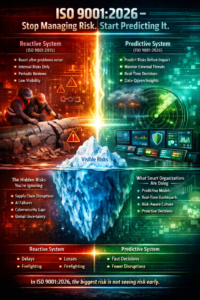
From Traditional Systems to Adaptive Frameworks
Earlier versions of ISO 9001 focused heavily on documentation, standardization, and process control. While these elements remain important, ISO 9001:2026 expands the scope significantly. It introduces a broader perspective that integrates external factors, technological advancements, and organizational agility into the quality management system.
This shift changes the fundamental questions organizations must ask themselves:
- Are our systems capable of handling disruption?
- Can we anticipate risks beyond our internal processes?
- Are we leveraging technology responsibly and effectively?
- Do our processes adapt quickly to changing conditions?
By addressing these questions, organizations move from a reactive approach to a proactive and predictive model of quality management.
Key Transformations in ISO 9001:2026
1. From Risk Awareness to Risk Anticipation
- Organizations must identify and evaluate external risks such as environmental changes, geopolitical factors, and supply chain disruptions
- Proactive planning is required to anticipate potential challenges before they occur
- Risk management becomes a continuous, dynamic activity rather than a periodic assessment
- Decision-making must incorporate real-time data and predictive insights
This transformation ensures that organizations are not caught off guard by unexpected events. Instead, they are prepared to respond quickly and effectively.
2. From Digital Adoption to Digital Accountability
- Automated systems and AI-driven processes must be validated for accuracy and reliability
- Data integrity, security, and traceability become critical requirements
- Organizations must establish clear governance over digital tools and platforms
- Employees need training to manage and monitor evolving technologies
Digital transformation is no longer optional. However, with increased reliance on technology comes increased responsibility. ISO 9001:2026 ensures that organizations maintain control over their digital environments while maximizing efficiency.
3. From Supplier Evaluation to Ecosystem Management
- Continuous monitoring of supplier performance is required
- Organizations must assess risks across the entire supply chain network
- Contingency plans and alternative sourcing strategies should be established
- Strong communication and collaboration with partners are essential
Quality is no longer limited to internal operations. It extends across the entire ecosystem, making supply chain resilience a critical component of success.
Understanding the Broader Impact
One of the most significant impacts is the shift toward external awareness. Organizations must now consider factors such as market trends, regulatory changes, environmental conditions, and technological advancements. This broader perspective enables them to identify opportunities and risks more effectively.
Another important aspect is the emphasis on flexibility. Unlike previous versions, which often required rigid structures, ISO 9001:2026 allows organizations to design systems that fit their unique needs. This flexibility encourages innovation and continuous improvement, making quality management more practical and relevant.
The Role of Leadership in the New Standard
Leadership plays a crucial role in the successful implementation of ISO 9001:2026. The standard requires top management to take an active role in integrating quality into the organization’s strategic direction. This means moving beyond delegation and ensuring that quality is embedded in every aspect of the business.
Leaders are expected to:
- Align quality objectives with organizational goals
- Promote a culture of accountability and continuous improvement
- Ensure that resources are available to support the quality management system
- Encourage collaboration across departments
By taking ownership of quality, leadership can drive meaningful change and create a strong foundation for long-term success.
Technology as a Strategic Enabler
Technology is at the heart of ISO 9001:2026. It enables organizations to collect, analyze, and utilize data in ways that were not possible before. However, the standard emphasizes that technology must be managed carefully to ensure its effectiveness.
Organizations need to focus on:
- Ensuring the accuracy and reliability of automated processes
- Protecting sensitive data from security threats
- Maintaining transparency in digital operations
- Continuously monitoring system performance
When used effectively, technology becomes a powerful tool for improving efficiency, reducing errors, and enhancing decision-making.
Building a Knowledge-Driven Organization
Another key aspect of ISO 9001:2026 is the recognition of knowledge as a strategic asset. Organizations are required to actively manage their knowledge resources to ensure continuity and growth.
This includes:
- Capturing critical expertise and insights
- Sharing knowledge across teams and departments
- Preventing knowledge loss due to employee turnover
- Using knowledge to support innovation and improvement
A strong knowledge management system enhances organizational resilience and ensures that valuable information is not lost over time.
Preparing for the Transition
Transitioning to ISO 9001:2026 requires a structured and strategic approach. Organizations should begin by assessing their current systems and identifying gaps in relation to the new requirements.
Key steps include:
- Conducting a gap analysis to evaluate existing processes
- Updating risk management practices to include external factors
- Implementing digital governance frameworks
- Enhancing supply chain monitoring and resilience
- Training employees to understand and adapt to the new standard
Starting early allows organizations to make gradual improvements and avoid last-minute challenges.
Creating a Culture of Quality
ISO 9001:2026 emphasizes that quality is not just the responsibility of a single department—it is a collective effort that involves everyone in the organization. Creating a culture of quality requires engagement, communication, and commitment at all levels.
Organizations should focus on:
- Encouraging employees to take ownership of their roles
- Promoting collaboration and teamwork
- Recognizing and rewarding contributions to quality improvement
- Providing continuous learning and development opportunities
A strong culture of quality leads to better performance, higher customer satisfaction, and increased employee engagement.
Flexibility as a Competitive Advantage
One of the most notable features of ISO 9001:2026 is its emphasis on flexibility. Organizations are no longer required to follow rigid frameworks. Instead, they can design systems that align with their specific needs and objectives.
This flexibility enables:
- Faster response to changes and disruptions
- Greater innovation and experimentation
- Improved efficiency and effectiveness
- Enhanced ability to meet customer expectations
By embracing flexibility, organizations can turn quality management into a powerful competitive advantage.
Opportunities for Growth
Despite the challenges, ISO 9001:2026 creates significant opportunities for organizations to improve their performance and achieve sustainable growth.
Some of the key opportunities include:
- Enhanced resilience in the face of uncertainty
- Improved decision-making through data-driven insights
- Stronger relationships with suppliers and partners
- Increased customer trust and satisfaction
Organizations that embrace these opportunities will be better positioned to succeed in a competitive and rapidly changing environment.
Conclusion
ISO 9001:2026 represents a fundamental shift in how organizations approach quality management. It moves beyond traditional concepts of control and compliance, focusing instead on adaptability, intelligence, and resilience.
For organizations willing to embrace this change, the benefits are substantial. They can build systems that not only meet requirements but also drive innovation, improve performance, and support long-term success.
In a world where uncertainty is the norm, ISO 9001:2026 provides a roadmap for navigating complexity and achieving excellence. It is not just an update to a standard—it is a transformation in the way organizations think about quality.

