FSSC 22000 V7’s Boldest New Clause: Governing AI in Canada
FSSC 22000 Version 7 introduces a brand-new requirement in Canada and everywhere else the scheme operates: any use of artificial intelligence in certification-related activity must be covered by an ethical, fair, and compliant governance framework, a clause that has no equivalent in Version 6. This guide explains what the AI governance requirement actually means for Canadian certified organizations and certification bodies, why FSSC added it, and what to do before your site transitions.
Key Changes at a Glance
- Version 7 adds a first-ever requirement to govern AI use in certification-related activity.
- The governance framework must be ethical, fair, and compliant, not just a technical control.
- This applies to both certified organizations and certification bodies using AI tools.
- The clause arrives alongside updated auditor qualification rules aligned with GFSI 2024 requirements.
- Canadian sites already certified move to Version 7 at their next scheduled audit, not a new cycle.
- FSSC has published a transition timeline; confirm exact cascade dates with your certification body.
- Version 6 certificates remain valid and auditable in Canada throughout the transition window.
What the New AI Governance Requirement in FSSC 22000 Version 7 Actually Says
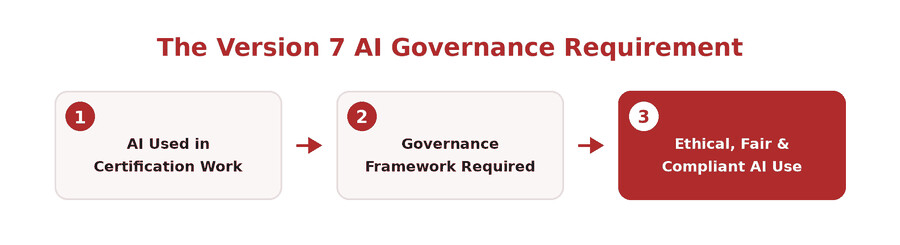
For the first time, FSSC 22000 Version 7 requires that any use of AI in certification-related activity be covered by an ethical, fair, and compliant governance framework. That scope includes AI used by certified organizations as part of their food safety management system, and AI used by certification bodies themselves as part of the audit and certification process, which makes this a two-sided requirement rather than one aimed only at certified sites.
In practice, a governance framework means documented policies describing where and how AI tools are used, how outputs are checked for accuracy and fairness, who is accountable for decisions influenced by AI, and how compliance with relevant laws and ethical expectations is maintained. It is not a requirement to avoid AI altogether; it is a requirement to use it in a controlled, auditable way.
This clause did not exist in Version 6 in any form, which makes it one of the most genuinely new additions in the entire Version 7 update, alongside the sustainability requirements and the revised PRP references drawn from the ISO 22002-x:2025 series.
For Canadian organizations, the practical implication is that auditors will now ask a question that simply was not part of a Version 6 audit: how is AI use in your certification-related activity governed, and who is accountable for it? Being able to answer that clearly, with supporting documentation, is what separates a smooth Version 7 audit from one that surfaces an unexpected gap.
Why FSSC Is Addressing AI Now: GFSI, ISO 22000, and Emerging Technology Risk
FSSC 22000 is benchmarked against GFSI’s Benchmarking Requirements and built on the ISO 22000 food safety management standard, and both GFSI and ISO have been paying increasing attention to how emerging technologies, including AI, affect the reliability of certification and audit outcomes. FSSC’s decision to add an explicit AI governance clause in Version 7 reflects that broader direction rather than a response to any single incident.
AI tools are increasingly used across food safety and quality functions in Canada and globally, from document review to supplier risk scoring to audit scheduling and even draft audit reporting. Without a governance requirement, the scheme would have no consistent way to assess whether those tools are being used responsibly, which creates risk for the credibility of certificates issued under the scheme.
By requiring an ethical, fair, and compliant framework rather than banning specific tools, FSSC keeps the requirement adaptable as AI technology and Canadian regulatory expectations continue to evolve, which is consistent with how the scheme has historically handled other management-system topics.
This mirrors a pattern seen in other Canadian and international governance frameworks, where regulators and standards bodies increasingly ask organizations to document how automated tools are checked, who is accountable, and how bias or error is caught, rather than prescribing a fixed list of approved technologies. FSSC’s approach lets certified organizations in Canada apply the same governance thinking they may already use for other technology risk areas.
What Canadian Certified Organizations Should Do About AI Governance
Start with an honest inventory: where is AI already used across your food safety management system, quality processes, supplier management, or documentation, even informally? Many organizations use AI-assisted tools without a formal policy simply because no one has been asked to document it, and that gap is exactly what Version 7 now requires you to close.
Once you know where AI is used, build a short governance document that names the tools, describes how outputs are checked before being relied on, assigns accountability to a named role, and confirms the use is compliant with applicable Canadian law and your organization’s own ethical standards. This does not need to be lengthy to satisfy an auditor, but it does need to be real and specific rather than a generic statement.
Because Canadian sites already certified to FSSC 22000 move to Version 7 at their next scheduled surveillance or recertification audit, and Version 6 certificates remain valid in the meantime, there is time to build this governance framework properly rather than assemble it at the last minute.
It is also worth reviewing this alongside any existing Canadian privacy, data protection, or AI-related obligations your organization already follows. In many cases, the same accountable owner who manages those obligations can extend their scope to cover FSSC 22000’s AI governance requirement, rather than standing up an entirely separate process just for certification purposes.
Common Misconceptions About the AI Governance Clause
The biggest misconception is that this requirement only applies to organizations actively building or deploying advanced AI systems. In reality, it applies to any use of AI in certification-related activity, which can include everyday tools like AI-assisted document drafting or data analysis that many teams already use without thinking of it as “AI governance.”
A second misconception is that not using AI means this clause can simply be ignored. Even organizations with no current AI use should be prepared to state that clearly and describe how they would govern AI if it were introduced, since auditors may still ask the question during a Version 7 audit.
A third misconception is that this is purely a certification-body concern rather than something certified organizations need to worry about. The requirement explicitly covers certification-related activity performed by certified organizations themselves, not only by the certification body auditing them.
A fourth misconception is that a single, generic AI policy borrowed from another department or another standard automatically satisfies this clause. Auditors will look for a framework that is specifically connected to certification-related activity, with clear accountability and evidence of ethical, fair, and compliant use, rather than a broad statement with no practical link to how AI is actually used day to day.
How IAS Training Helps Canadian Teams Build AI Governance Competence
Because the AI governance clause is entirely new, most food safety and quality teams have never been trained on how an auditor will actually assess it, which makes structured Version 7 training especially valuable for this particular requirement.
We recommend that Canadian quality leaders explore our FSSC 22000 Lead Auditor and Internal Auditor Training programs to understand exactly how AI governance is assessed alongside the scheme’s other Version 7 changes, including the updated auditor qualification rules and PRP references, so your team walks into its next audit prepared rather than guessing.
If you want the fuller picture of everything changing in Version 7 before committing to a specific course, our FSSC 22000 certification page for Canada lays out every major change, including the sustainability and food chain category updates that often intersect with AI governance planning at multi-site organizations.
FSSC 22000 Version 6 vs Version 7: AI Governance at a Glance
| Aspect | Version 6 | Version 7 |
|---|---|---|
| AI governance requirement | No requirement exists | Any AI used in certification-related activity must sit inside an ethical, fair, and compliant governance framework |
| Scope of the requirement | N/A | Applies to both certified organizations and certification bodies |
| Auditor qualification | Prior GFSI benchmarking alignment | Aligned with GFSI Benchmarking Requirements version 2024 |
| Certification path for existing Canadian sites | N/A | Transition occurs at the next scheduled surveillance or recertification audit |
| Certificate validity during transition | N/A | Version 6 certificates remain valid and auditable throughout the transition window |
Note: exact FSSC 22000 Version 6 to Version 7 transition/cascade dates should be confirmed directly with your certification body.
About the author
Adekoya Oluwatosin is a food safety consultant, trainer and FSSC 22000 v6 Lead Auditor with over eight years of hands-on experience across food manufacturing, packaging, storage & distribution and catering. She has personally conducted more than 22 internal audits — including FSSC 22000 and ISO 9001:2015 audits — and led FSMS/QMS implementation projects that guided over ten organizations to certification.
Frequently Asked Questions
What is the FSSC 22000 Version 7 AI governance requirement?
It is a new clause requiring that any use of AI in certification-related activity be covered by an ethical, fair, and compliant governance framework, applying to both certified organizations and certification bodies.
Does this AI governance clause exist in FSSC 22000 Version 6?
No. There is no equivalent requirement in Version 6; AI governance is one of the genuinely new additions introduced in Version 7.
Do Canadian organizations that don’t use AI need to do anything?
Yes, in a limited sense. Even organizations with no current AI use should be able to state that clearly and describe how AI would be governed if introduced, since the requirement can still come up during an audit.
Will Canadian sites need a completely new audit for the AI governance clause?
No. Already-certified Canadian sites pick up the AI governance requirement at their next scheduled surveillance or recertification audit rather than through a new certification cycle.
When does the AI governance requirement take effect in Canada?
FSSC has published a transition timeline, but exact cascade dates vary by certification body, so confirm your specific transition date directly with your certification body.