
HACCP Certification Cost in USA: A Complete Guide
Need a straight answer about HACCP certification cost at your own site? Tell us what you make, where you make it and how many shifts you run, and we will scope it properly. Start with HACCP certification in the USA, read the IAS blog on what certification costs or contact the IAS team.
Nobody searches for HACCP certification cost out of curiosity. They search because a buyer, a retailer, a co-packer or an insurer has asked for the certificate, and somebody has to put a number in a budget line. This guide will not print that number. It does something more useful. It shows you what the number is made of, which parts you control, and which parts are set by the shape of your own operation.
That is not evasion. A certification quote is built from your facts, not from a rate card. Two bakeries on the same street can sit far apart because one runs a single shift and one product family, while the other runs three shifts, two buildings and a co-manufacturing agreement. A published figure would be wrong for almost everyone who read it.
✓ IAS is accredited by UQAS | ✓ Food safety audits by sector-experienced auditors | ✓ Clear scoping before any proposal | ✓ Training and certification under one roof
Why this HACCP certification cost guide contains no price figures
Certification is priced from effort, and effort is estimated from evidence about your business. Before anyone can quote, they need your scope, your process count, your site count, your headcount across shifts, and the hazard profile of what you handle. Change any of those and the effort changes with it.
You will find pages online that publish a range. Treat them carefully. A range wide enough to be honest is too wide to budget against. A range narrow enough to budget against is hiding assumptions about size and risk that probably do not match yours. The rest of this guide is about the drivers behind the cost of HACCP certification instead, and the same logic runs through every ISO certification in the USA scheme we audit. Read it with a pen.
Who IAS is, and who assesses IAS
Integrated Assessment Services, trading as IAS, audits and certifies management systems, and food safety sits alongside the other system certification schemes it runs. When IAS audits your food safety system and issues a certificate, that certificate carries weight only if someone independent has checked that IAS itself works properly. That is what accreditation is for.
IAS is accredited by UQAS. UQAS assesses IAS against the requirements that apply to certification bodies: auditor competence, impartiality, how decisions are made, how complaints are handled, and how certificates are granted, suspended and withdrawn. It is a recurring assessment, not a one-time stamp.
One point deserves saying plainly, because it is often blurred. Accreditation is an assessment of IAS. It is not a recommendation of any certified food business. Your certificate says your system was audited and found to conform. It does not say an accreditation body examined your business or approved your products.
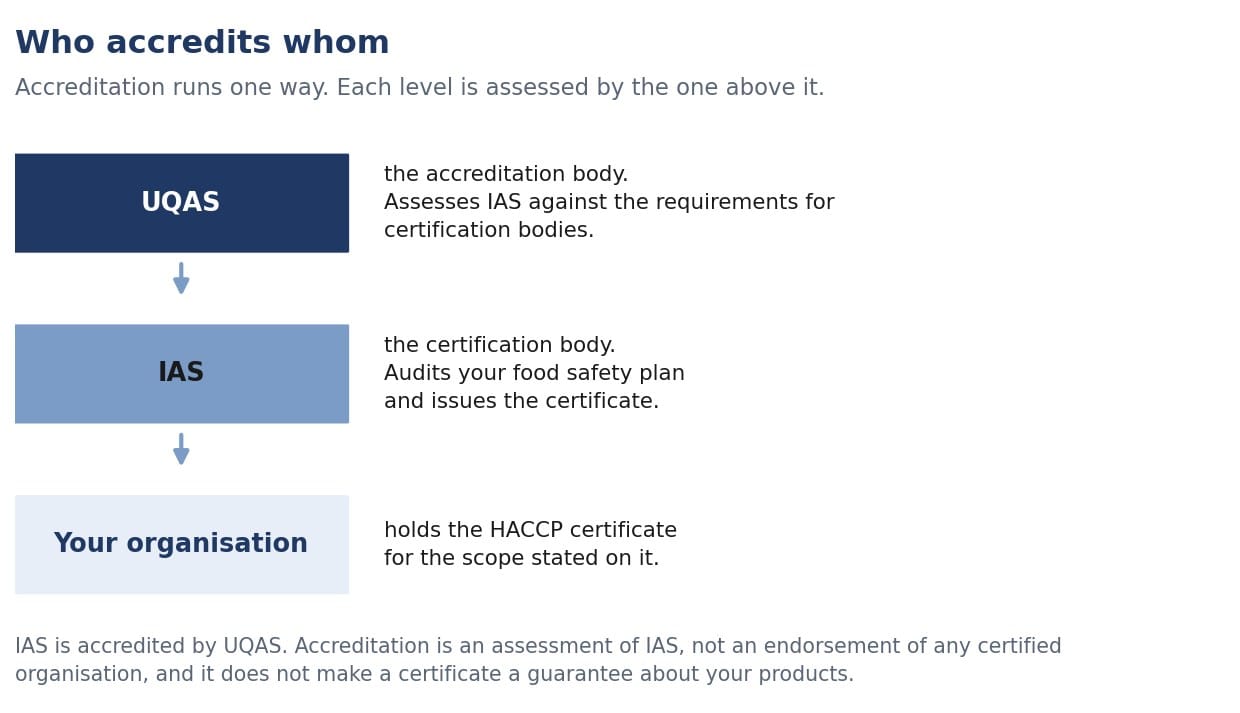
Why this belongs on a cost page: accreditation is part of what you are buying. An audit run under an accredited scheme has rules about auditor qualification, audit planning, evidence and decision review. Those rules take time, and time is the main input to price. An unaccredited certificate is cheaper because less happens.
The scope decision that sets the size of everything
Scope is the largest single lever on cost, and it is decided before any auditor arrives.
Scope answers three questions. Which products or product families are covered? Which processes, from intake to dispatch? Which physical locations? Every yes adds hazard analysis work, adds documents, adds records to sample and adds audit hours.
The common mistake is scoping wide to impress a customer. A scope covering every line you have ever run, including the seasonal one you make twice a year, costs more to prepare, more to audit and more to maintain. Scope what you genuinely sell today.
The opposite mistake is scoping so narrow that the certificate does not satisfy the buyer who triggered all this. Read their request carefully. If they named a product, a facility or a process, your scope statement must cover it in words they will recognize.
What actually drives HACCP certification cost
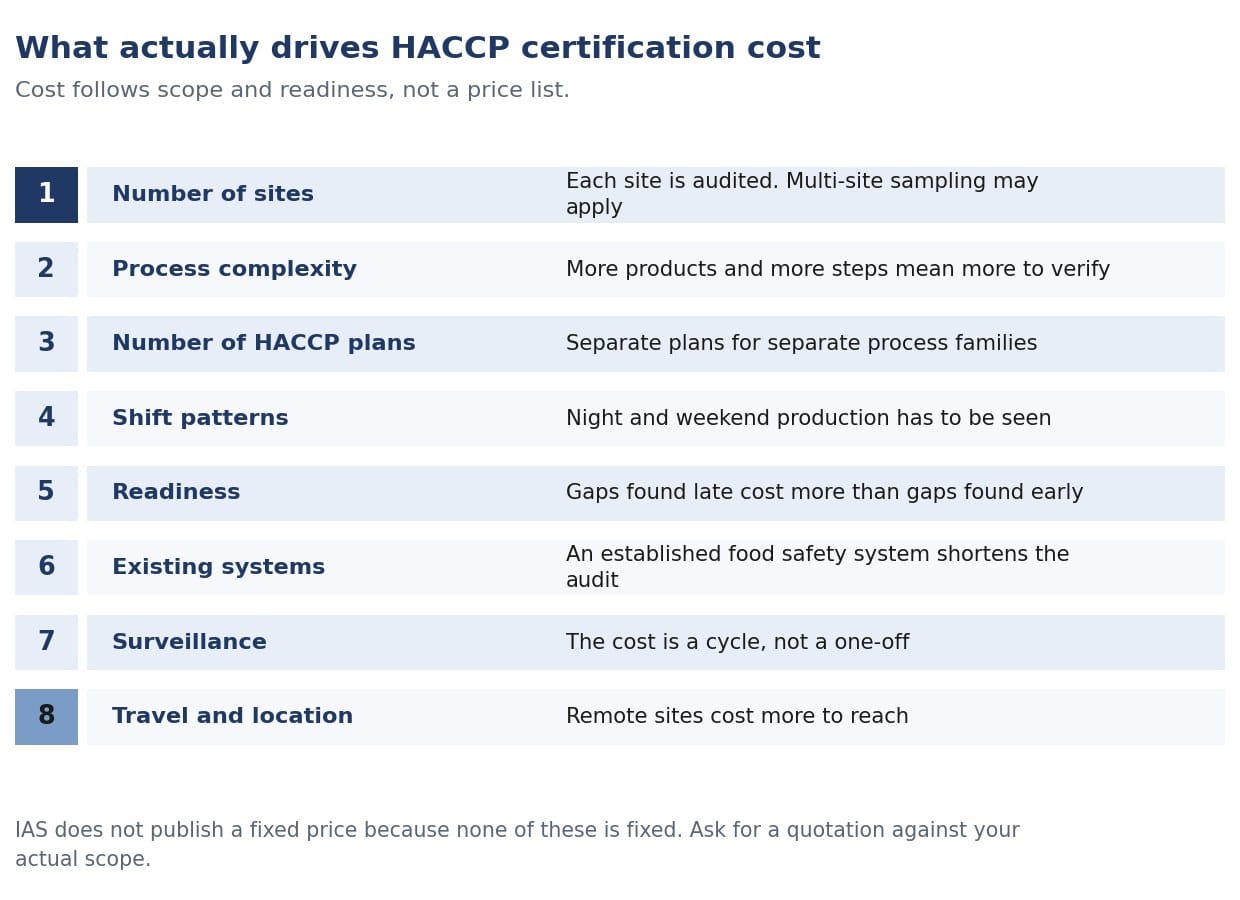
Nothing in this table is a price. Every row is a question a scoping conversation will ask, and why the answer moves effort up or down.
| Driver | Why it moves effort | What pushes it upward |
|---|---|---|
| Scope breadth | Each product family carries its own hazard analysis and records | Many unrelated product types on one certificate |
| Number of sites | Each location needs its own evidence and usually its own visit | Multiple plants, separate warehouses, off-site storage |
| Process complexity | More steps means more hazards to analyze and more controls to verify | Thermal processing, allergens, raw and ready-to-eat under one roof |
| Hazard profile | Higher-risk categories demand deeper verification | Ready-to-eat, vulnerable-consumer products, allergen claims |
| Headcount and shifts | Auditors sample people and practice, not just paper | Several shifts, high turnover, agency labor |
| System maturity | A system already running generates its own evidence | Starting from nothing, or from a folder nobody opens |
| Internal capability | Someone in-house who understands the system shortens everything | No trained internal auditor, no named HACCP team leader |
| Corrective action load | Findings must be closed and the evidence reviewed | Major nonconformities at the certification audit |
| Travel and access | Auditor time on the road is still auditor time | Remote sites, restricted access windows, seasonal shutdowns |
Read the right-hand column as a checklist. Most of it is within your control, and several rows can be improved before you request a proposal. The same drivers shape effort on adjacent schemes too, which is why the cGMP certification and product certification pages describe scoping in much the same terms.
Preparation is where most of the effort sits
This surprises people. The audit is the visible event, so it gets the attention. But for a business starting without a working system, the larger share of total effort goes into preparation, and most of that is your own people’s time.
Preparation means writing prerequisite programs that describe what you actually do. It means a HACCP team with real authority. It means doing the hazard analysis honestly, identifying critical control points, setting limits you can hold, and building monitoring a supervisor can run on a busy Friday. Then it means running the system long enough to produce records.
That last part is the one people skip, and the most expensive thing to skip. An auditor needs evidence that the system has operated, not only that it has been written. A system switched on the week before the audit has nothing to show. Our guide to HACCP certification requirements sets out what must exist before you book anything, and how to get HACCP certification walks the sequence in order.
Who does the work matters too. In-house effort consumes hours but builds knowledge that stays. Consultant effort is faster but leaves less behind unless you insist on handover. Training sits between the two: HACCP training in the USA and internal auditor training put the capability inside your building, which lowers what you spend in every later year. Teams that also run a food safety management system often add ISO 22000 internal auditor training, or ISO 22000 lead auditor training for the person who will own the programme.
The audit stages you are paying for
A certification audit is not one visit. Understanding the stages shows where effort accumulates.
You scope and apply. The certification body reviews your documented system and says whether it is ready. An on-site audit examines the system in operation, sampling records, watching practice and interviewing people at every level. Findings are raised and you close them with evidence. An independent reviewer inside the certification body then makes the decision — the auditor does not grant the certificate. Surveillance then keeps it alive. The certification process page sets out the full sequence, and the audit procedure page explains how the audit is conducted.
Each stage has a cost consequence. A documentation review that returns significant gaps means rework before anyone travels. Findings mean time closing them and time reviewing the closures. Unready systems consume more of everyone’s hours.
Who does what, and who pays for it
Confusion about responsibility creates unplanned cost. This is the split.
| Activity | Your organization | Certification body |
|---|---|---|
| Defining scope | Proposes what to cover, supplies the facts | Confirms it is auditable and states it on the certificate |
| Hazard analysis and CCPs | Owns it entirely | Audits it, cannot write it for you |
| Procedures and records | Owns it entirely | Reviews the documented system |
| Training your team | Arranges and pays for it | Delivers training as a separate service |
| Running the system before audit | Owns it entirely | Requires evidence that it ran |
| Audit planning | Provides access and availability | Plans the audit, assigns competent auditors |
| Findings | Responds with root cause and correction | Raises and evaluates them |
| Closing findings | Supplies the corrective action evidence | Reviews, accepts or rejects the evidence |
| The certification decision | No role | Independent review and decision inside the body |
| Mark usage | Uses the mark correctly | Publishes the rules, monitors misuse |
| Maintaining the system between audits | Owns it entirely | Verifies it at surveillance |
The middle column carries the important lesson. A certification body cannot design your system and then audit it — impartiality rules forbid it. If you need someone to build the system, that is a separate engagement, budgeted separately. Mark usage also carries rules worth reading early; see the logo usage guideline.
Ready versus not ready
Most avoidable cost comes from arriving unready. Here is what each state looks like on the floor.
| Area | What ready looks like | What unready looks like |
|---|---|---|
| HACCP team | Named members, defined roles, a leader with authority | One person doing it alongside another full-time job |
| Hazard analysis | Written for your actual process, step by step | Copied from a template for a different product |
| Critical limits | Defensible, and achievable in real production | Numbers nobody on the floor recognizes |
| Monitoring | Logged at the stated frequency, signed, legible | Gaps on weekends and night shifts |
| Corrective actions | Recorded, including the decision on affected product | A note saying “fixed” with no product decision |
| Verification | Scheduled, performed, documented independently of monitoring | Planned but never done |
| Internal audit | Completed across the scope, findings closed | Not started, or done by the procedure’s author |
| Management review | Held, minuted, with decisions and owners | An email saying everything is fine |
| Staff awareness | Operators explain their own CCP without prompting | Only the quality manager can answer anything |
Every row on the right is a likely finding. Findings extend the audit, delay the certificate and consume your team’s time twice — during the audit, and again afterward.
What makes HACCP certification cost go up
Some increases are unavoidable because they reflect genuine complexity: multiple sites, higher-risk categories, allergen segregation, processes with several critical control points. If you run raw and ready-to-eat product in one building, the verification burden is real and preparation does not remove it.
Self-inflicted increases are different. Scoping wider than needed. Booking the audit before records exist. Losing your trained HACCP leader with no successor. Treating the system as a binder rather than a way of running the plant. Letting monitoring lapse between surveillance visits, so each one becomes a recovery exercise.
There is also the cost of switching. Changing certification bodies mid-cycle usually means a fresh certification audit rather than picking up the surveillance schedule. Choose deliberately the first time.
What you can do to bring it down
Scope tightly and honestly. Cover what you sell and what your customer asked about. Extend later when you need to.
Run the system before you book. Give it enough operating time to generate genuine records. This one decision removes more findings than anything else.
Build capability inside. A trained internal auditor and a competent team leader cut preparation time, cut findings and cut dependence on outside help every year afterward. The training schedule is the place to start, and the wider ISO training in the USA and GMP training listings show what else your team can pick up in the same trip.
Fix the obvious first. Audit yourself against the right-hand column above and close what you find. Fixing a gap yourself costs far less than fixing it under a finding.
Combine what can be combined. If you are also pursuing ISO 22000, FSSC 22000 or BRC or ISO 9001, say so at scoping. Shared documentation and coordinated visits reduce duplicated effort. Raise it early; combining is hard once the plans are written.
Budget HACCP certification cost for the cycle, not the event
A certificate is not a purchase. It is a cycle. Budgeting for the first audit alone is the most common planning error on a food safety program.
Across the certificate’s life, expect the initial certification work, surveillance at defined intervals, recertification at the end of the cycle, the internal cost of maintaining monitoring and verification, and training for new staff. If you run an environmental or occupational health and safety system as well, the ISO 14001 and ISO 45001 cycles follow the same rhythm and can be planned against the same calendar.
Then there are changes. A new line, a new site or a new product category may need the scope extended, and an extension is assessed on its own merits. Tell your certification body when material changes happen, not at the next surveillance visit. Late disclosure is more disruptive than early notice.
What a HACCP certificate is evidence of
Be precise about this, internally and with customers.
A HACCP certificate means that, on the audit dates, a competent auditor sampled your documented food safety system and its operation within the stated scope and found it conforming. It means an independent decision-maker inside the certification body reviewed that evidence and granted the certificate.
It does not mean every batch you produce is safe. It does not cover every site or product you own — only what the scope states. It does not test your products, and it is not a product approval. It is not a guarantee of any outcome, and it does not replace your own controls between audits. An audit is a sample taken at a point in time. The safety of what leaves your dock each day is produced by your people, not by the certificate on the wall.
Say this plainly to your sales team, before they say something else to a customer.
On legal duties
This page makes no claim about the law in any country, state or municipality. It does not tell you what any regulator requires of your business, and nothing here should be read as a statement of your legal obligations.
Food businesses operate under rules that vary by jurisdiction, by product category and by sales channel. Certification and legal compliance are different things, and one does not stand in for the other. Take your legal duties to your own attorney or regulatory advisers and decide with them what applies. Use this page for what it is: an explanation of how certification effort is priced.
Get a scoped HACCP certification cost proposal instead of a guess. Send us your scope, sites, shifts and product families, and we will tell you what the work involves. Visit IAS, browse the IAS blog or get in touch.
Frequently asked questions
Why will nobody publish a HACCP certification cost or a fixed HACCP certification price?
Because effort is estimated from your facts — scope, sites, processes, shifts, hazard profile. A published figure would be wrong for most readers. A scoped proposal is built against your actual operation.
What information do I need before asking for a HACCP certification cost quote?
Your proposed scope in words, your product families, your site addresses, your process steps from intake to dispatch, your headcount across shifts, and whether a working system already exists.
Is preparation or the audit the bigger part of the effort?
For a business starting without a system, preparation usually dominates, and most of it is your own team’s hours. With a mature system already running, the balance shifts toward the audit and the surveillance cycle.
Can IAS build my HACCP system and then certify it?
No. Impartiality rules prevent a certification body from designing the system it audits. Building the system is a separate engagement with a separate provider.
Does IAS hold accreditation?
Yes. IAS is accredited by UQAS. That accreditation is an assessment of IAS as a certification body — its auditor competence, impartiality and decision-making. It is not an endorsement of any organization IAS certifies.
Will a bigger scope always raise HACCP certification cost?
More scope means more hazard analysis, more records and more audit coverage, so yes, effort rises. Scope what you sell and what your customer asked for, then extend when you need to.
What happens if the auditor raises findings?
You investigate the root cause, correct it and submit evidence. The certification body reviews that evidence before the decision. Findings are normal; a large number of them signals the system was audited before it was ready.
Does certification end once the certificate is issued?
No. Surveillance continues through the cycle and recertification follows at the end of it. A system that lapses between audits turns each surveillance visit into a recovery exercise.
Can HACCP be combined with other food safety certifications?
Often, yes. Sites pursuing ISO 22000 or FSSC 22000 share documentation and internal audit effort with HACCP. Raise it at scoping so audit plans can be coordinated from the start.
Does the certificate cover all my sites automatically?
No. Only what the scope states. Adding a site or a product category means the scope must be extended and assessed. Tell the certification body when the change happens.
Where can I read more before deciding?
Start with HACCP certification in the USA, then the general certification FAQ and what drives certification cost across schemes. If cGMP is on your list as well, the cGMP internal auditor training page explains how that capability is built in-house.