
FDA Certification in USA
Someone has asked your company for “FDA certification.” You searched for it, and you landed here. The honest answer comes first: the FDA does not certify companies. There is no FDA certificate, no FDA logo you can put on a carton, and no auditor who arrives from the agency to hand you one. What exists instead is a set of regulatory steps — registration, listing, quality system expectations, and for some devices a premarket submission. Those are duties you carry out yourself. What a certification body like IAS can do is assess how ready your systems are against published quality requirements, and report what it found. This page explains what those requests really mean, section by section, so you can answer the customer who asked.
Asked for FDA certification you cannot produce? Talk it through with a real assessor before you promise anything. Contact IAS or read the certification process in USA.
✓ IAS is accredited by UQAS | ✓ Independent, documented assessments | ✓ Clear scope on every certificate | ✓ No claims we cannot support
“FDA Certification” Is Not Something Anyone Can Sell You
Start with the plain statement, because a lot of marketing blurs it. The US Food and Drug Administration regulates food, drugs, devices, cosmetics, biologics and tobacco products. It inspects. It clears. It authorizes. It does not run a certification scheme for manufacturers, and it does not accredit private certification bodies to hand out FDA certificates on its behalf.
So if a supplier, an importer or a marketplace asks for “FDA certification,” they almost always mean one of four other things. They want proof you are registered. They want your product listed. They want evidence your quality system is under control. Or they want the clearance letter for a device. Ask which. The conversation gets much shorter once you do.
What People Actually Mean When They Ask for FDA Certification
The request usually arrives by email, with no detail. Before you spend money, find out what the requester needs to see in their file. This table separates the four common meanings.
| What they say | What they usually need | What it is not |
|---|---|---|
| “Send your FDA certificate” | A registration number, or a listing record | A certificate issued by the FDA |
| “Are you FDA approved?” | Evidence the product may lawfully be marketed | A blanket approval of your company |
| “We need GMP proof” | Evidence of a documented, followed quality system | A permanent state you achieve once |
| “Send the 510(k)” | The clearance letter and its stated intended use | An approval, or a quality verdict |
Read the right-hand column twice. Most disputes between a supplier and a buyer come from the right-hand column, not the left.
Registration and Listing, In Plain Terms
FDA registration means telling the agency who you are and where you operate. Facilities that manufacture, process, pack or hold regulated products generally have to do it, and renew it on a cycle. It is an administrative record. It creates a number.
That number is not a badge of quality. It says the agency knows your address. It does not say anyone has visited, reviewed your batch records or agreed that your product is fit for sale. Companies that print a registration number next to a tick mark on a label are inviting a problem, and the same caution applies to certification marks, which have their own rules — see the guideline for usage of logos in USA. Say what the number is, and nothing more.
Listing is a separate step. It is the record of what you actually make at that registered site. Registration covers the establishment. Listing covers the products. They are often confused because they are filed around the same time and through the same account.
Keeping listings current matters more than it first appears. Products get discontinued. Device models change. Contract manufacturers are swapped. If the listing no longer matches what leaves your dock, the record is wrong, and a wrong record is what an inspector notices first.
GMP Conformity: The Part That Is Actually Work
Good Manufacturing Practice is where the real effort sits. It is not a document you buy. It is the daily discipline of controlled processes, trained people, calibrated equipment, traceable materials, cleaning that is verified rather than assumed, and records that can be produced without a panic.
This is also the part an independent assessment can genuinely help with, because GMP expectations map closely onto recognized quality management structures. Many organizations build the backbone with cGMP certification in USA, then strengthen the foundation with ISO 9001 certification in USA. Device manufacturers usually work to ISO 13485 certification in USA, which is built for the sector and its documentation habits. Food sites more often head toward ISO 22000 certification in USA or HACCP certification in USA.
None of these replaces a regulatory duty, and none of them amounts to FDA certification. They give you the evidence base that makes FDA compliance work much less painful when the agency, or your customer, comes asking.
A 510(k) Is a Clearance, Not an Approval
For many medical devices, the route to market runs through a premarket notification, known as a 510(k). The submission argues that your device is substantially equivalent to a legally marketed predicate device. If the agency agrees, it issues a clearance letter.
Clearance is not approval. The word matters, and regulators are strict about it. Clearance means the device may be marketed for the intended use described in the submission. It is not a finding that the device is safe in every use, not a quality award, and not transferable to a different model or a different claim. If you want to understand the mechanics, the page on 510(k) submission in USA sets out what a file contains, and the 510(k) submission process page walks through the sequence step by step. Where a buyer is really asking about the product rather than the system, product certification in USA is the separate route to look at.
Who IAS Is, and Who Assesses IAS
This section exists because accreditation claims get repeated carelessly across this industry, and we would rather be exact.
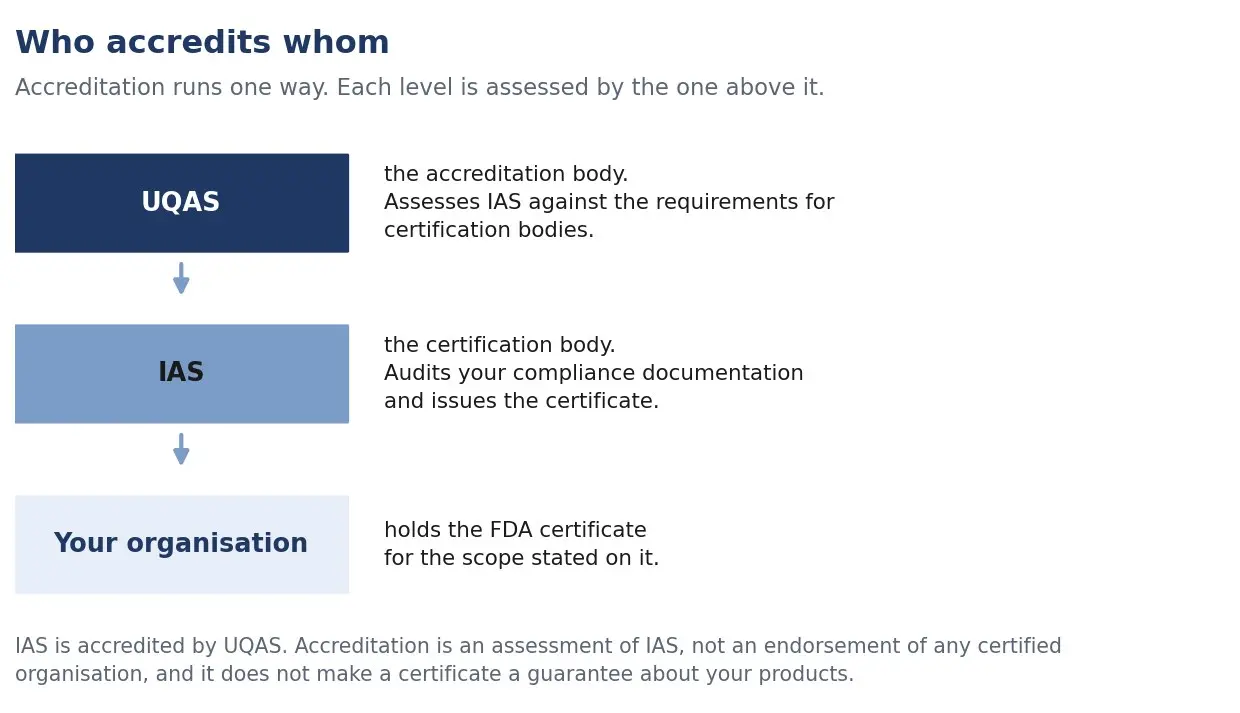
IAS is a certification body. We assess management systems and products against published standards, and we issue certificates describing what we found. IAS is accredited by UQAS. UQAS is the accreditation body that assesses IAS: our competence, our impartiality arrangements, our auditor qualifications, and how we reach and record decisions.
One point deserves saying plainly. Accreditation is an assessment of IAS. It says nothing about the standing of any client we certify. When UQAS accredits IAS, it is judging our work, not your factory. Your certificate stands on your own audit evidence and nothing else.
The about us page sets out who IAS is.
What an Independent Assessment Does and Does Not Do
Be exact about the boundary. This is the table to show your customer when they push.
| What an IAS assessment does | What it does not do |
|---|---|
| Reviews your documented quality system against a named standard | Register your establishment or file your listing |
| Tests whether procedures are actually followed on the floor | Replace, satisfy or shortcut any FDA requirement |
| Records nonconformities in writing, with evidence | Make your product lawful to sell in any market |
| Checks that records are retrievable and traceable | Guarantee the outcome of any inspection |
| Issues a certificate with a defined scope and validity | Grant FDA certification, or call you “FDA approved” |
| Revisits at surveillance intervals to confirm continuity | Prove anything about sites outside the audited scope |
If a provider offers you something in the right-hand column, that is your answer about the provider.
The Readiness Pathway, Step by Step
The sequence below is the one most manufacturers follow. It is not a legal route map. It is how the preparation work tends to fall into order.
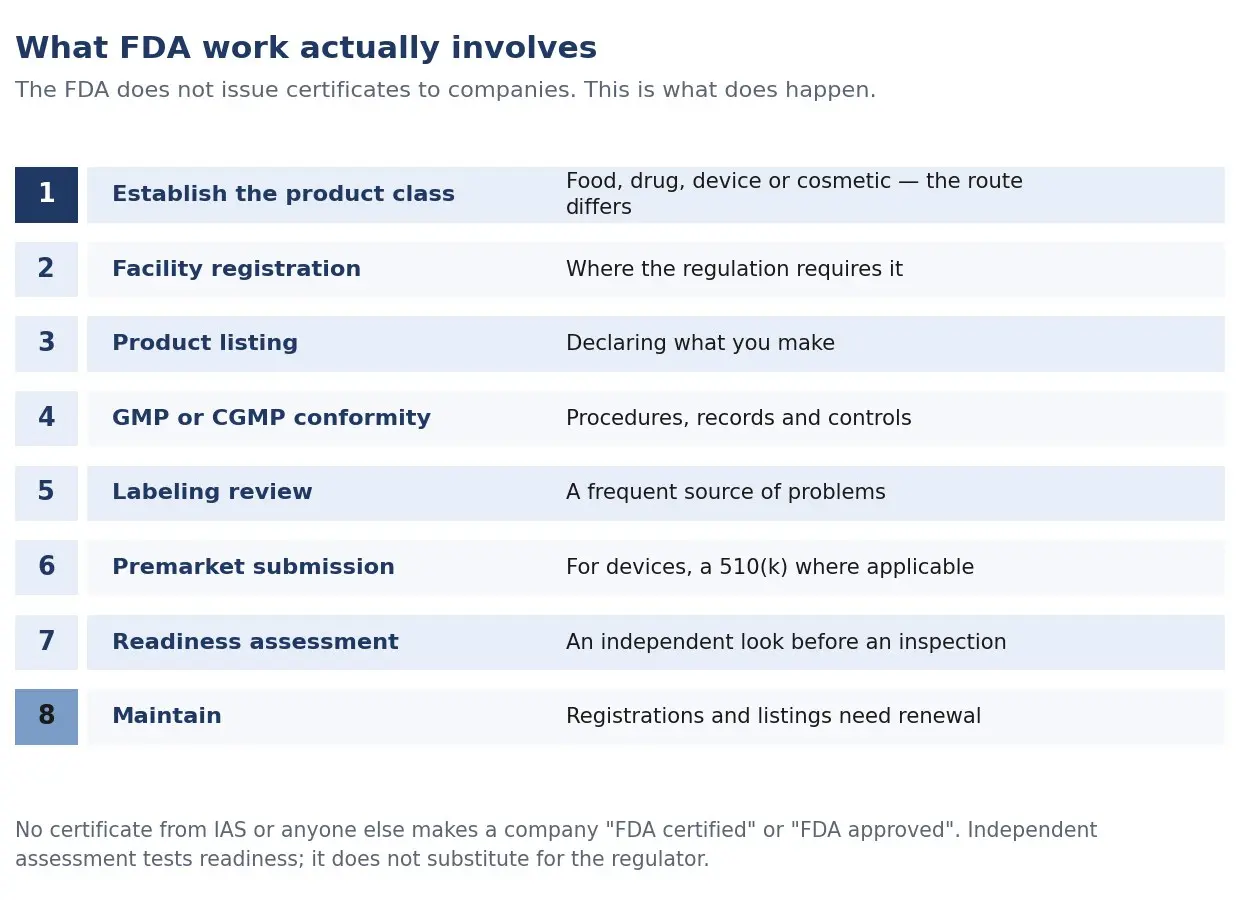
The two-stage structure is standard. Stage one looks at whether your documentation and planning hold together. Stage two tests whether the site does what the documents say. Between them you get time to fix what stage one found. The general shape is described in the ISO audit procedure in USA page. One caution worth repeating: an IAS audit is not an FDA audit, and neither one stands in for the other.
What Holds Up Under Scrutiny, and What Does Not
Auditors form a view quickly. Usually within an hour of arriving. Here is what separates the two impressions.
| Area | Strong evidence | Thin evidence |
|---|---|---|
| Records | Produced in minutes, dated, signed, legible | Assembled the night before, gaps explained verbally |
| Change control | Every process change traced to an approval | Changes made, documents updated later or never |
| Training | Competence tied to specific tasks and verified | A signed attendance sheet and nothing else |
| Complaints | Logged, investigated, closed with evidence | Handled by email, never reaching the system |
| Supplier control | Approved list, criteria, evidence of monitoring | Purchasing by habit and price alone |
| Internal audit | Finds real problems before the external auditor does | Reports that never raise a nonconformity |
| Corrective action | Root cause addressed, effectiveness checked later | The same finding reappearing every cycle |
None of that is exotic. It is just done, consistently, when nobody is watching.
Four failure patterns repeat. First, treating registration as certification, then printing that claim on packaging. Second, letting listings drift out of date after a product change. Third, building a quality manual that describes an idealized factory nobody works in. Fourth, assuming a 510(k) clearance covers a later variant of the device. It does not.
A fifth, quieter failure is scope confusion. A certificate covers named sites and named activities. If you add a line, a facility or a product family, the certificate does not stretch to cover it automatically. Tell your certification body.
Training the People Who Have to Hold This Together
Systems fail at the human layer. If one person understands the quality system, you do not have a quality system. Practical routes include ISO 13485 internal auditor training in USA for device teams, cGMP internal auditor training in USA for manufacturing staff, and GMP training in USA for a broader floor audience. Where the quality system sits on ISO 9001, ISO 9001 internal auditor training in USA builds the same habit in the wider team, and the full range is listed under ISO training in USA. Current dates sit on the training schedule.
What a Certificate Means, and What It Does Not
A certificate issued by IAS records that, at the time of the audit, the audited system met the requirements of the named standard within the stated scope. That is the whole claim.
What was assessed: the documented system, sampled records, sampled activities at the named sites, and interviews with the people doing the work. What was not assessed: everything outside that scope, every day other than the audit days, and the regulatory status of your products. Auditing is sampling. A certificate is not a guarantee of product safety, not a guarantee of future performance, and not a defense if the system is abandoned the week after. It stays valid only while surveillance confirms the system is still running.
This Page Makes No Claim About the Law
Nothing here states or interprets the law of the United States or of any other country. We describe what regulatory steps are commonly called and how independent assessment relates to them. We do not tell you what you are legally required to do. Your obligations depend on your products, your classification, your markets and your contracts. Those are questions for your own regulatory counsel and legal advisers, and you should put them to those advisers before acting.
Getting Started When a Buyer Asks for FDA Certification
Three sensible moves. Ask the requesting customer, in writing, exactly what document they want in their file. Check whether your registration and listing records are current and correct. Then pick the standard that matches your sector and run an honest gap review against it before anyone external arrives.
If you are unsure which scheme fits, the overview page for system certification in USA is a reasonable starting point, the wider list sits under ISO certification in USA, and the frequently asked questions page covers the procedural ground. Sites that also carry environmental or safety obligations often run the same gap review against ISO 14001 certification in USA and ISO 45001 certification in USA at the same time, which saves a second round of preparation later.
Frequently Asked Questions About FDA Certification
Is there such a thing as FDA certification for my company?
No. The FDA does not issue certificates to manufacturers. It maintains registration and listing records, inspects facilities, and issues clearances or authorizations for certain products. A private body cannot issue an FDA certificate either.
My buyer insists on “FDA certification.” What do I send?
Ask what they need in their file. Usually it is a registration number, a current listing record, a clearance letter, or evidence of a quality system. Send what actually exists, with a short note explaining what each document is.
Does an IAS certificate count as FDA certification?
No, and we will not say otherwise. An IAS certificate is an independent assessment against a published standard. It does not replace, satisfy or shortcut any regulatory requirement, and it does not make your product lawful to market.
Is a 510(k) clearance the same as approval?
No. Clearance means the device may be marketed for the intended use stated in the submission, on the basis of substantial equivalence to a predicate. Approval is a different regulatory pathway and a different word. Do not use them interchangeably.
Who accredits IAS?
IAS is accredited by UQAS. UQAS assesses our competence, impartiality and decision-making as a certification body. That accreditation is about IAS, not about the organizations we certify.
Which standard should a medical device manufacturer choose?
Most work to ISO 13485, because it is written for the sector’s design controls, traceability and documentation expectations. Background reading sits on ISO 13485 requirements.
We are a food facility. Where do we start?
Usually with hazard analysis. HACCP is the common base, with ISO 22000 or FSSC 22000 layered on where customers require a recognized food safety scheme. See FSSC 22000 certification in USA if a retailer has named it.
Does registration mean the FDA has inspected us?
No. Registration is an administrative record of who you are and where you operate. It carries no statement that anyone has visited or reviewed anything.
How long does a certificate stay valid?
Certificates run for a defined period and depend on surveillance activity confirming the system is still operating. If surveillance does not happen, or the system lapses, validity is affected.
Can one certificate cover all our sites?
Only those named in the scope. Adding a site, a production line or a product family does not extend the certificate by itself. Tell the certification body and have the scope reviewed.
What if the audit finds problems?
That is normal, and it is the point. Findings are recorded with evidence, you address root cause, and the correction is verified. A clean report with no observations is often a sign of a shallow audit, not a strong system.
Where can I read more about how certification actually works?
The IAS blog covers process questions in detail, including the ISO certification process.
Get a straight answer about what you actually need. Start with the FDA certification in USA inquiry route, or reach the team through IAS.