
CE Certification in USA: What CE Marking Actually Requires
Been asked for a CE certificate by a European buyer? Start with a short, honest conversation about what CE certification actually requires for your product. Talk to IAS or read the certification process in USA before you commit to anything.
✓ IAS is accredited by UQAS | ✓ Straight answers about scope | ✓ US-based support teams | ✓ No claims we cannot stand behind
Start with the thing most pages get wrong about CE certification
CE marking is a declaration made by the manufacturer. Whatever the phrase “CE certification” suggests, it is not a certificate handed over by a certification body. When you affix the CE mark, you are the one saying the product meets the applicable European requirements. Your name is on the Declaration of Conformity. Your signature. Your liability.
IAS does not issue a CE certificate. IAS is not a notified body. Notified bodies are designated by EU member state authorities under EU law, and that designation is a specific legal status that no accreditation of a certification body substitutes for. IAS cannot affix the CE marking to your product, and neither can any consultant.
That is an uncomfortable opening for a services page. We are writing it anyway, because the alternative is selling you something that does not exist. Plenty of pages in this market imply that a CE certificate can be bought. Buyers in Europe know better, and a document that looks wrong will cost you the order.
So what is left? Quite a lot, actually. The evidence behind a CE declaration is mostly management system evidence, test evidence and documentation discipline. That is where a certification body earns its keep, and it is the part of the work a US manufacturer can genuinely get help with.
Who does what: manufacturer, notified body, certification body
The roles are separate on purpose. Mixing them up is the single most common reason a US exporter ends up with paperwork a European customer will not accept.
| Role | Who holds it | What they actually do |
|---|---|---|
| Manufacturer | You | Decides which requirements apply, builds the technical file, signs the Declaration of Conformity, affixes the marking |
| Authorized representative | A person or firm established in the EU | Holds documentation and acts as a contact point on the manufacturer’s behalf |
| Notified body | An organization designated by an EU member state authority | Carries out third-party conformity assessment where the applicable route calls for it |
| Accredited certification body (IAS) | IAS | Audits and certifies management systems, supports product certification work, and assesses the discipline behind your CE certification file |
| Test laboratory | An accredited lab | Runs the tests your file relies on and issues the reports |
Read that table twice. The CE marking sits in the first row, not the fourth. What IAS brings is in the fourth row, and it is real work, but it is different work.
Who IAS is, and who assesses IAS
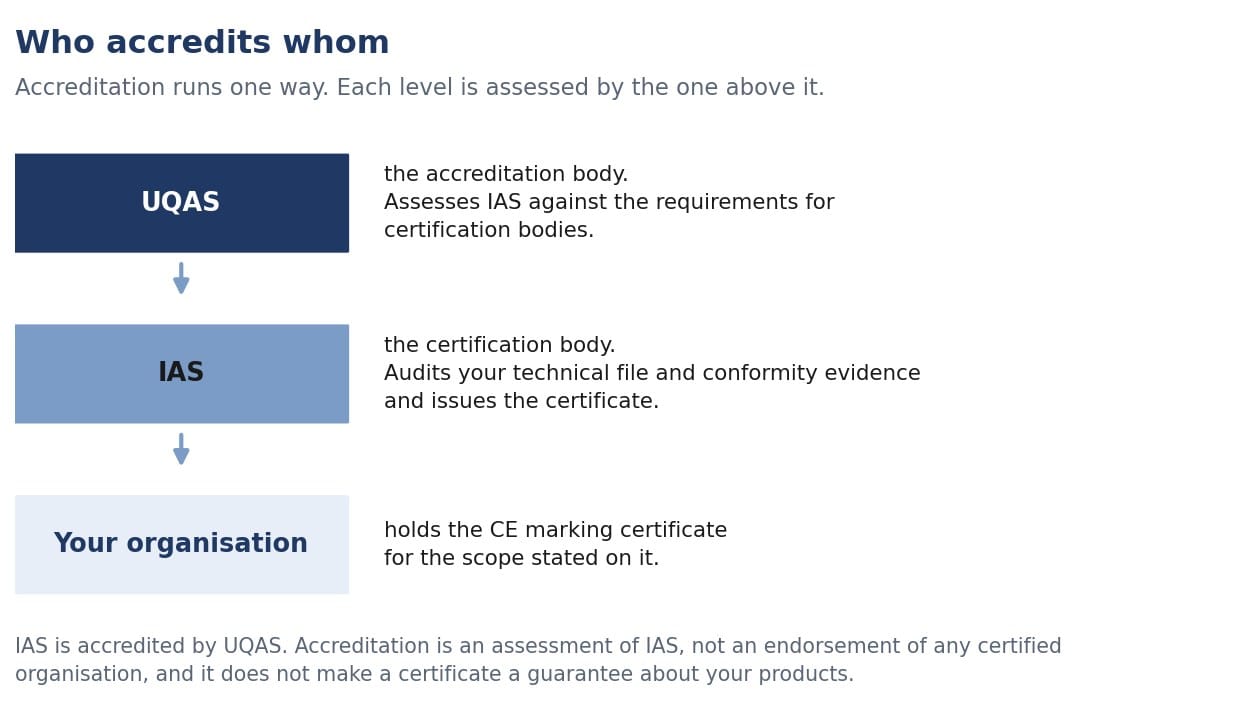
IAS is a certification body. Like any certification body worth using, IAS is itself assessed by an outside party rather than simply asserting its own competence. IAS is accredited by UQAS.
That accreditation means UQAS has assessed IAS — its impartiality arrangements, its auditor competence, its decision-making, its record keeping. It is an assessment of the certification body. It says nothing about the merits of any company IAS has certified. A client company does not become accredited because its certifier is. That distinction matters, and it gets blurred constantly in marketing copy.
There is more about the organization on the about us page. If you want to see how accreditation language is used properly elsewhere, the note on ISO 9001 accreditation covers the same ground for a different scheme.
The work IAS does in the United States divides into system certification in USA and product certification in USA, with the scheme-by-scheme detail under ISO certification in USA. None of those is a CE certificate, and keeping that line visible is part of why this page exists. Two product schemes sit close to the CE questions buyers ask: RoHS certification in USA for restricted substances in electrical and electronic equipment, and PPE certification in USA for protective equipment.
What accreditation does not do for your CE certification file
Being audited by an accredited certification body does not make your product compliant with European requirements. It is not a step in CE certification, it does not shortcut a conformity assessment route, it does not replace testing, and it does not give you standing you would otherwise lack.
What it does is give an outside reader a reason to trust the system that produced your file. A buyer reviewing your documentation is asking a quiet question: does this company control its design changes, its suppliers, its records? A certified quality system answers part of that question with evidence rather than assurance.
That is the honest value. It is narrower than the promise most pages make, and it is worth more than the promise, because it survives scrutiny.
Where your conformity assessment route comes from
Different product families sit under different European legislation, and each piece of legislation sets out its own routes. Some routes are self-declaration based. Others require third-party involvement. Which one applies to you depends on what the product is, what it does, and how it is classified under the relevant framework.
The route is the part people most want a shortcut for, and there is not one. We are not going to tell you which route yours is. That determination belongs to you and to advisers who know your product and the current legislation. What we can do is set out the shape of the decision so you know what you are looking at.
| Question to answer first | Why it decides the route | Where the answer usually comes from |
|---|---|---|
| Which European legislation covers this product? | Every route lives inside a specific piece of legislation | Product definition, intended use, your regulatory adviser |
| Is there a risk classification? | Higher classes typically pull in third-party assessment | The classification rules in the applicable legislation |
| Are harmonised standards available? | Using them changes how you demonstrate conformity | Standards listing for that legislation |
| Does the route name a notified body? | Only the legislation can answer this | The conformity assessment modules set out in the text |
| What testing does the route rely on? | Determines which lab reports your file needs | The standards you have chosen to apply |
| Who is your EU-based contact? | Documentation has to be reachable within the EU | Your distributor, importer or appointed representative |
Work top to bottom. Skipping the first row and jumping straight to “who tests this” is how companies end up with a stack of valid test reports that answer the wrong question.
The technical file is the real deliverable
Ask what a CE certification project produces and most people say “the certificate.” There isn’t one, in the self-declaration case. What there is, is a technical file, and it is the thing that gets asked for when a customs authority, a market surveillance body or a serious buyer wants proof.
A technical file typically pulls together the product description, design and manufacturing drawings, the list of standards applied, risk assessment, test reports, labeling and instructions, and the signed EU declaration of conformity that names the product and the legislation it is declared against. It has to be current. It has to match the product you are actually shipping today, not the prototype from two years ago.
That last point is where management system discipline stops being abstract. If your change control is weak, your file drifts out of date quietly, and nobody notices until someone asks.
How IAS work usually runs alongside a CE certification project
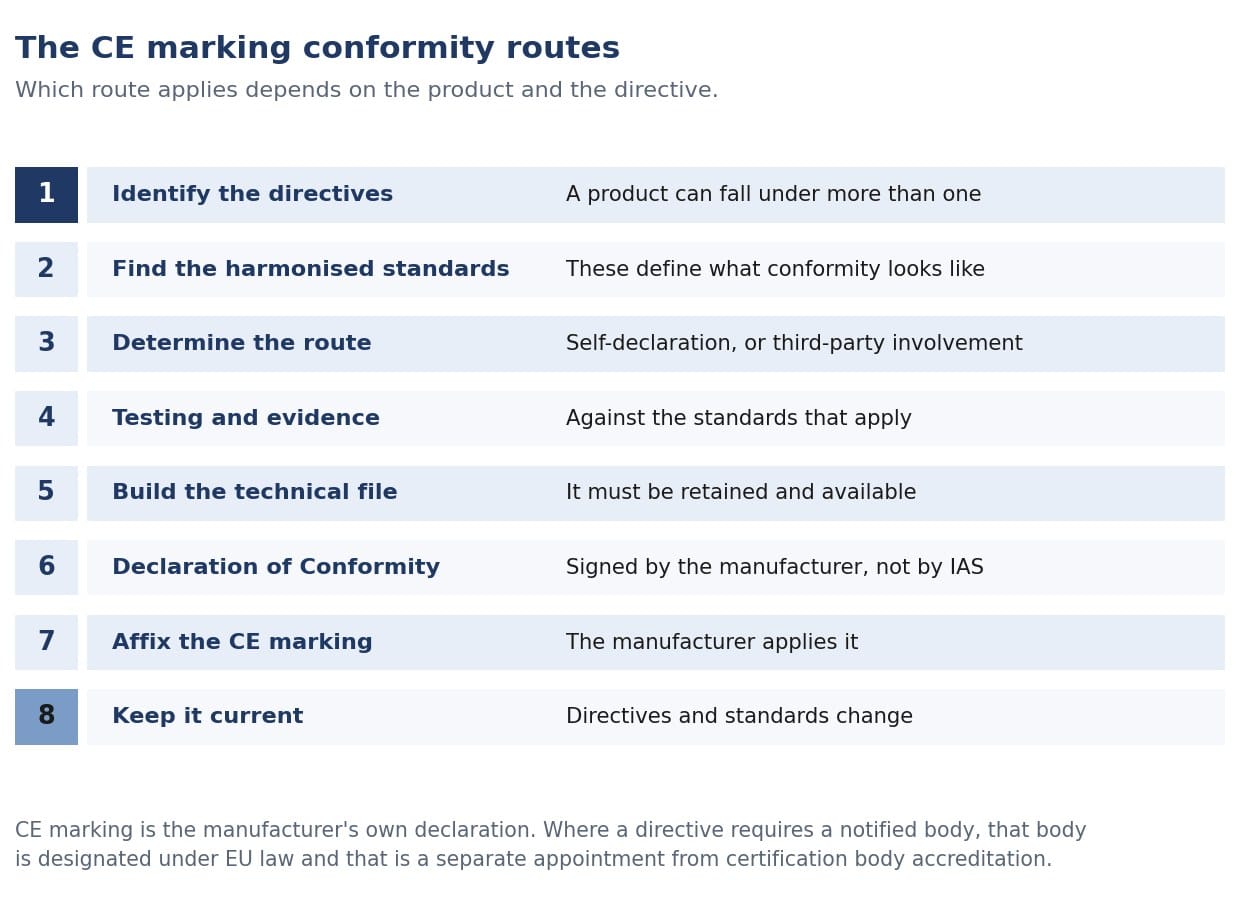
In practice the two tracks run side by side. The CE certification track is yours. The IAS track is a management system certification, or a product certification engagement, scoped to what you make.
It begins with an application and a scoping conversation — what the product is, which sites, which processes. Then a document review. Then an on-site or remote audit in stages, depending on the scheme. Then a decision made by people who did not conduct the audit, which is one of the impartiality requirements an accreditation assessment checks. The ISO audit procedure in USA page sets out the mechanics. For product-side work, see product certification procedure in USA.
Most manufacturers approaching CE work already hold, or are pursuing, ISO 9001 certification. Medical device makers will be looking at ISO 13485 certification instead, and often at 510(k) submission for the US side in parallel. Electrical and electronic products frequently pair CE work with restricted-substances evidence. Food contact and food processing exporters usually have ISO 22000 certification in the same conversation, and pharmaceutical and cosmetics manufacturers cGMP certification. Protective equipment has its own testing expectations again.
Where a site is remote from our nearest office, work is often coordinated through the associate partners in USA network, which changes the logistics of an audit rather than its substance.
Strong file, weak file
Here is what separates a file that survives a buyer’s review from one that gets bounced back. No statistics, no percentages — just what the two look like when you open them.
| Element | What a strong file looks like | What a weak file looks like |
|---|---|---|
| Scope statement | Names the exact model, variants and intended use | Vague product family, no variants listed |
| Standards applied | Specific standards with edition and year, and a reason for each | A list copied from a competitor’s document |
| Test reports | From an accredited lab, matching the current product build | Reports for an earlier revision, or unaccredited |
| Risk assessment | Signed, dated, linked to specific design decisions | A generic template with nothing product-specific |
| Change control | Every design change traced back into the file | Nobody can say when the file was last reviewed |
| Instructions and labeling | In the languages the destination markets need | English only, translated late or not at all |
| Declaration of Conformity | Signed by a named person with authority | Unsigned draft, or signed by someone who has left |
| Document location | Retrievable within the EU on request | Sitting on one engineer’s laptop in Ohio |
The weak column is not a caricature. It is what we see when companies treat CE as a formality to clear rather than a file to maintain.
What usually goes wrong
Assuming a supplier’s certificate covers you. A component certificate covers the component. Your finished product is a different thing, and the declaration on it is yours.
Buying “CE certification” from a broker. Documents circulate that look official and mean nothing. European buyers increasingly check. When a document does not trace back to a real assessment, the order goes elsewhere.
Treating translation as an afterthought. Instructions and safety information in the right languages are part of the package, not an optional extra for later.
Letting the file go stale. You changed a supplier, a material, a firmware version. The file still describes the old one. This is the failure mode that catches otherwise careful companies.
Confusing US and EU requirements. FDA certification work and CE work are separate tracks with separate evidence. Neither substitutes for the other.
What a certificate from IAS means, and what it does not
Where IAS certifies a management system or carries out product certification work, the certificate says something specific and limited. It says that at the time of the audit, against the stated scope and the stated standard, the auditors found the system conforming. It names what was assessed.
It does not assess everything you do. It does not cover activities outside the scope on the certificate. It does not confirm conformity with European product legislation, and it is not a CE certificate. It is not a guarantee of future performance, of product safety, or of any particular outcome in a tender or a market.
A certificate is a snapshot backed by surveillance. It is evidence of discipline, not a warranty. Anyone who tells you otherwise is overselling.
A note on law
This page describes how conformity assessment generally works. It makes no claim about the law in the United States, in any EU member state, or anywhere else, and nothing here should be read as a statement of your legal duties.
European product legislation changes. Classifications change. Harmonised standards get superseded. What applies to your product, in your destination markets, on the date you ship, is a question for your own legal and regulatory advisers. Get that advice. Do not get it from a marketing page — including this one.
Related certification and training
Companies working toward European market access often have several tracks running at once. Environmental expectations from buyers point toward ISO 14001 certification. Worker safety commitments point toward ISO 45001 certification. Information security questionnaires from EU customers point toward ISO 27001 certification. Energy reporting duties in some destination markets bring up ISO 50001 certification. Food exporters have their own scheme choices to make.
On the people side, internal capability matters more than it first appears. Internal auditor training builds the habit of checking your own evidence before someone else does. Teams that own the quality system usually go further with ISO 9001 lead auditor training, and the environmental and safety equivalents are ISO 14001 lead auditor training and ISO 45001 lead auditor training. The full range sits under ISO training in USA, and dates are on the training schedule.
If you use an IAS certification mark, the guideline for usage of logos sets out what is allowed. Using a certification mark in a way that implies CE conformity is not allowed, and it is exactly the kind of thing that damages a company in front of a European buyer.
Frequently asked questions about CE certification
Can IAS issue a CE certification or a CE certificate for my product?
No. IAS does not issue CE certificates and is not a notified body. CE marking is a declaration the manufacturer makes. IAS certifies management systems and carries out product certification work that supports the evidence behind your file.
Then why would I involve a certification body in CE certification at all?
Because most of what a technical file rests on is systems evidence — change control, supplier control, records, competence. An audit against a recognized standard tests that, and gives your buyer something independent to look at.
Is IAS accredited?
Yes. IAS is accredited by UQAS. That accreditation is an assessment of IAS as a certification body. It does not extend to the organizations IAS certifies, and it does not make any product CE compliant.
Do I need a notified body?
That depends entirely on the legislation covering your product and the conformity assessment route it sets out. Some routes involve one; some do not. Work it out with advisers who know your product, not from a general page.
We already have ISO 9001. Does that help with CE certification?
It helps with the discipline, not the declaration. A certified quality system is good evidence that your file will be maintained properly. It is not a substitute for the conformity assessment work itself.
Who signs the Declaration of Conformity?
Someone at the manufacturer with the authority to bind the company. Not a consultant, not a certification body, not a lab. The person’s name and role go on the document.
What if my product changes after I sign?
You review the file. A material change can affect the standards applied, the test evidence and the declaration itself. This is why change control is the part of a quality system that matters most for CE work.
Can I use test reports from any laboratory?
Reports are more credible when they come from an accredited lab working to the right standard. ISO 17025 certification is the accreditation standard for testing laboratories, and it is worth checking what your lab actually holds.
Does CE marking apply to products sold only in the US?
CE marking relates to placing products on the European market. If you never ship there, the question usually does not arise. Buyers sometimes ask anyway, because they plan to re-export.
How long does the IAS side take?
That depends on your scope, your sites and how ready your documentation is. We will not quote a duration on a web page, because any number here would be invented. Ask for a scoped answer.
What happens at surveillance?
Periodic audits check that the system is still running as certified. For CE purposes this is useful: it forces a regular look at whether the file still matches the product.
Where do I start with CE certification if I have no documentation at all?
Want a straight answer about what CE certification actually asks of you? No CE certificate will be sold to you here, because there is no such thing to sell. There is real work that makes your file defensible. Contact IAS and tell us what you make.