
RoHS Certification in USA
Asked for a RoHS certificate by a customer? Send us the product family, the bill of materials and the markets you ship to, and we will tell you what evidence you already have and what is still missing before you commit to RoHS certification. Talk to IAS
✓ IAS is accredited by UQAS | ✓ Component-level evidence review | ✓ Auditors who read test reports | ✓ Offices across the United States
What RoHS certification actually means
RoHS is a European Union directive. It restricts six metals and four phthalates in electrical and electronic equipment. The restriction applies to each homogeneous material inside the product, not to the product as an average.
RoHS certification is a voluntary, third-party check. A certification body reviews your technical evidence, tests the way you control your supply chain, and issues a certificate if the evidence holds together. The certificate is a statement about your product and your process. It is not a licence, a permit, or a government approval.
Most US manufacturers look at RoHS certification because a customer asked. A European distributor, a contract assembler, or a large OEM wants documentation before they will buy. That is a commercial requirement between two companies. Nothing here describes a legal obligation in the United States or anywhere else. It sits alongside the other voluntary schemes on our product certification in USA and ISO certification in USA ranges.
The restricted substances and where they hide
The threshold is a concentration in a homogeneous material. A homogeneous material is a piece that cannot be mechanically separated any further — the tin coating on a pin, the resin in a connector body, the ink on a label. You cannot dilute a failing material by weighing it against the rest of the assembly.
| Restricted substance | Maximum concentration by weight in a homogeneous material | Where it usually turns up |
|---|---|---|
| Lead (Pb) | 0.1% | Solder, brass fittings, PVC stabilizers, glass frit, free-machining alloys |
| Mercury (Hg) | 0.1% | Backlight lamps, some legacy switches and relays |
| Cadmium (Cd) | 0.01% | Pigments, plating, older contacts, some thick-film pastes |
| Hexavalent chromium (Cr VI) | 0.1% | Passivation and corrosion coatings on screws, brackets, enclosures |
| Polybrominated biphenyls (PBB) | 0.1% | Flame retardants in older plastics |
| Polybrominated diphenyl ethers (PBDE) | 0.1% | Flame retardants in housings and cable jackets |
| DEHP, BBP, DBP, DIBP | 0.1% each | Flexible cable, sleeving, gaskets, adhesives, soft-touch overmolds |
Cadmium is the one people miss. Its limit is ten times tighter than the rest, and it sits in colors — yellows, oranges, reds — that nobody thinks of as a chemical risk. If your team has never worked with a restricted substances list before, the worked examples on the IAS blog are a reasonable place to start.
Who IAS is, and who assesses IAS
Integrated Assessment Services — IAS — performs the assessment work. IAS is accredited by UQAS. UQAS assesses how IAS runs its certification work: auditor competence, impartiality arrangements, decision-making that is separate from the audit team, and the handling of complaints and appeals.
That accreditation is an assessment of IAS. It carries no approval of any manufacturer IAS certifies. Your certificate says your evidence met the scheme criteria on the day it was reviewed. It does not transfer UQAS’s opinion of IAS onto your product.
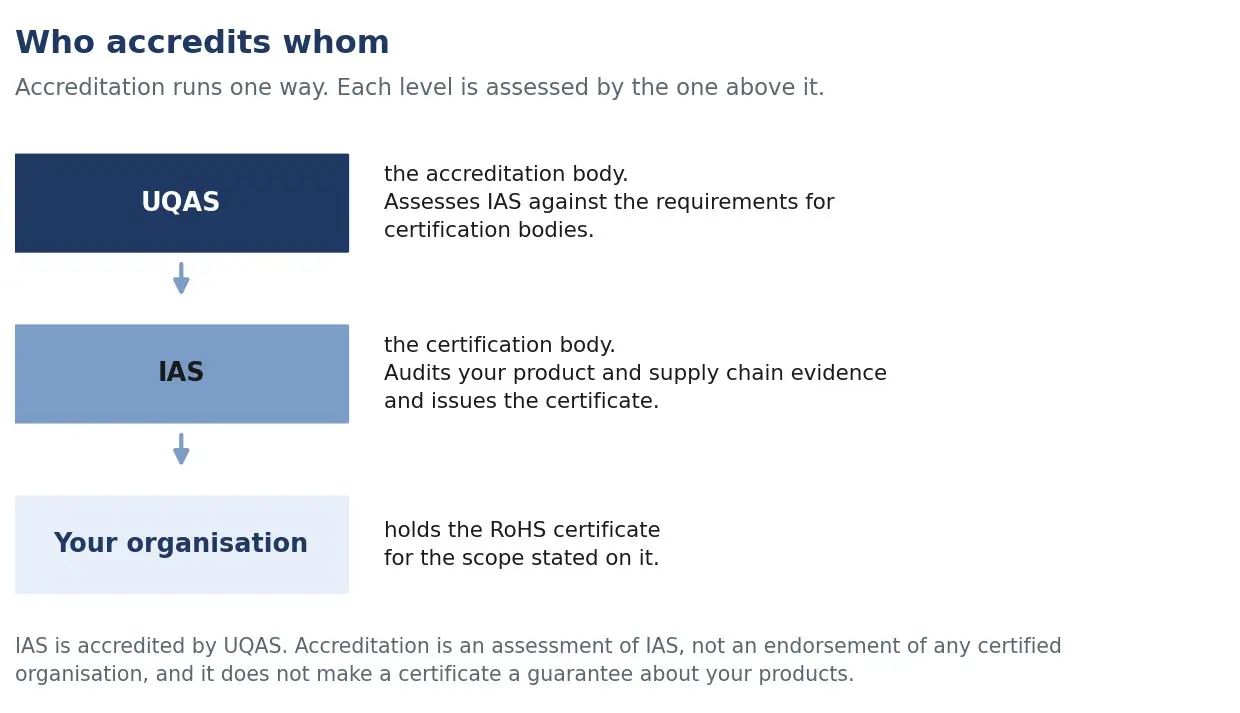
If a buyer asks who stands behind your certificate, the honest answer is short. IAS issued it. UQAS accredits IAS. Assessment work in the United States is delivered through our own offices and our associate partners in USA. Anyone claiming a certification body is accredited by an international forum of accreditation bodies has misunderstood how the structure works, and a technically literate customer will notice.
The angle nobody warns you about: evidence lives in the supply chain
You cannot test your way to RoHS conformity on a finished product alone. RoHS testing has its place, but a finished assembly might contain four hundred distinct materials, and XRF screening on the outside of a housing tells you about the housing.
RoHS compliance rests on component-level evidence, collected from the people who made each part. That is the whole job. Gathering it, filing it, and keeping it current is more work than any audit you will sit through. One undocumented part undermines the declaration for the entire product.
So the practical question is not “how do we pass the audit.” It is “can we produce a defensible file for every line on the bill of materials, and keep producing it when a part goes end-of-life.”
What strong evidence looks like against weak evidence
Auditors see the same weak files repeatedly. Here is the difference.
| Evidence item | Strong version | Weak version |
|---|---|---|
| Supplier RoHS declaration | Names the part number, states each restricted substance, signed and dated, references the substance list in force | A generic “we are RoHS compliant” letter with no part numbers |
| Test report | From a competent laboratory, identifies the homogeneous materials tested, gives measured values and detection limits | A certificate page with no measured data, or a report for a different variant |
| Bill of materials | Every line mapped to a declaration or report, including consumables like solder paste, flux, adhesive and ink | Only the electronic components listed; mechanical parts assumed fine |
| Exemption use | Exemption number recorded, applied to the specific part, with a review date | “Exempt” written in a column with no reference |
| Change control | Supplier must notify on material change; alternates are re-evidenced before use | Purchasing substitutes a part during a shortage and nobody tells quality |
| Document currency | Declarations refreshed on a schedule, undated ones rejected | A folder of PDFs collected years ago and never revisited |
The pattern is obvious once you see it. Strong evidence is specific to a part. Weak evidence is specific to a company.
Who does what
Responsibility for RoHS certification spreads across three parties, and confusion between them causes most of the delay.
| Task | Your supplier | Your team | IAS |
|---|---|---|---|
| Declare the substance content of a supplied part | Provides it, per part number | Requests, checks and files it | Reviews a sample for credibility |
| Identify homogeneous materials in a part | Usually knows the breakdown | Challenges vague answers | Tests whether your challenge is real |
| Decide analytical testing is needed | May supply a report | Decides which parts justify testing | Checks the reasoning, not just the result |
| Maintain the technical file | Not responsible | Owns it entirely | Samples it during the audit |
| Control engineering and purchasing changes | Notifies on material change | Re-evidences before release | Audits the change records |
| Issue the certificate | No role | No role | Decides, separately from the audit team |
Notice the last row. The person who audits you does not make the certification decision. That separation is one of the things UQAS checks when it assesses IAS.
How the RoHS certification pathway runs
The sequence is predictable. How long each step takes is decided by your preparation, not by the scheme.
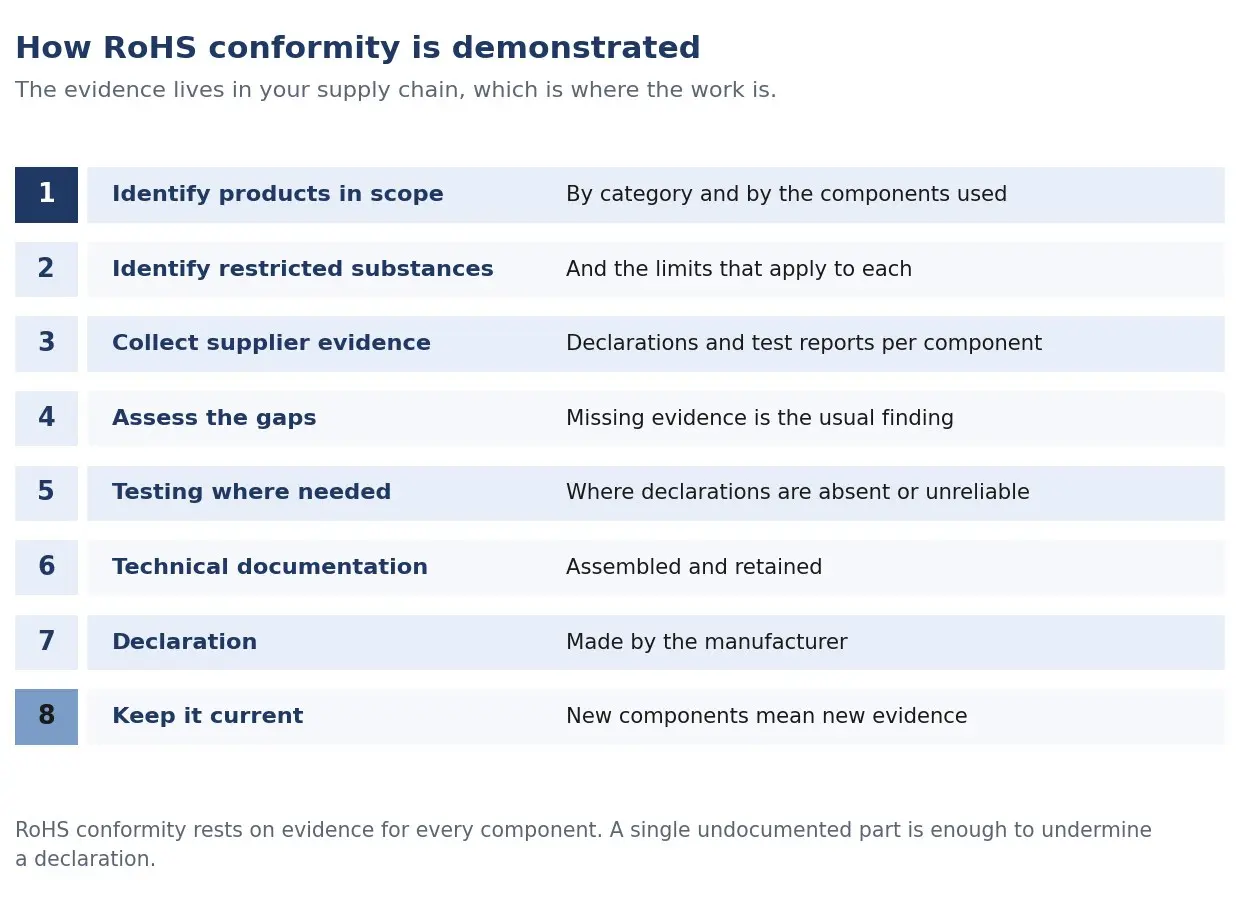
It starts with scope. You define the product family, the variants and the manufacturing sites. Then the technical file review: bill of materials, declarations, test reports, exemption records. Then the on-site or remote audit, which concentrates on whether the file reflects what actually happens in purchasing, engineering and goods-in.
Findings are raised, you correct them, and a separate reviewer makes the decision. Surveillance follows. Our general certification process in USA and the product certification procedure in USA describe the mechanics that apply across schemes.
Where declarations fall apart
Three failure modes account for most nonconformities.
Company-level letters. A supplier issues one PDF saying everything it makes is compliant. It has no part numbers and no substance data. It is unusable as evidence for a specific part.
Silent substitutions. A component goes on allocation. Purchasing finds a drop-in alternate with the same footprint and electrical rating. Nobody asks whether the plating is the same. The file still describes the original part.
Forgotten materials. Solder, flux, conformal coating, thread-locking compound, labels, ink, potting resin, cable ties. These are materials in the finished product. They belong in the file.
A fourth one is worth naming: inherited assemblies. If you buy a populated board, you own the evidence gap for every component on it. “Our contract manufacturer handles that” is not a file.
Exemptions age, and so does your file
Some applications of restricted substances carry exemptions — lead in certain high-melting-point solders, for example. Exemptions are specific, and they are reviewed over time. Recording an exemption number without recording which part uses it, and when to look at it again, leaves you exposed the moment it changes.
Build a review date into the file. When a declaration passes its review date and no refreshed version exists, treat the part as undocumented until it is re-evidenced.
What RoHS certification can and cannot show
This matters more than the marketing value, so read it slowly.
What was assessed: the technical evidence you presented for the defined scope, the controls you operate over supplier declarations and changes, and the consistency between your documented process and observed practice, sampled on the audit dates.
What was not assessed: every component in every variant, every shipment you have made or will make, the ongoing truthfulness of every supplier, and anything outside the stated scope.
A certificate is not a guarantee that no restricted substance exists anywhere in your product. It is evidence that a competent third party examined your file and your controls and found them sound against the scheme criteria. If your supply chain changes and your controls do not catch it, the certificate does not protect the product. You still carry the responsibility for what you ship.
The legal position
This page does not state the law in any country. Whether RoHS-style restrictions apply to you, how they interact with contractual commitments you have made, and what any market you sell into requires are questions for your own legal advisers.
We describe a voluntary certification scheme and what the audit examines. We do not present any government requirement, and nothing here should be read as advice about your obligations. Take legal questions to someone qualified to answer them.
Living with RoHS certification afterward
The file is a live thing. New part, new revision, new supplier site, new molding compound — each one is an evidence event. The companies that stay clean treat RoHS evidence as part of engineering change control, not as a compliance project that finished.
Surveillance visits look at exactly this. Not whether you had a good file once, but whether the file still matches the product you shipped last month.
Two practical points come up after the certificate arrives. The first is marks: how you may and may not present the certificate and the accreditation mark is set out in the guideline for usage of logos in USA. The second is people. If the engineer who built the file leaves, the file stops being maintained, so it is worth training more than one person — our ISO training in USA pages and the current training schedule show what runs and when.
Related certifications we handle
RoHS certification rarely travels alone. Many clients pair it with CE marking certification in USA for the same product family, and run it alongside a management system. Common combinations include ISO 9001 certification in USA for quality, ISO 14001 certification in USA for environmental management, and ISO 13485 certification in USA where the product is a medical device.
Electronics manufacturers often also look at AS 9100 certification in USA for aerospace work, ISO 45001 certification in USA for occupational health and safety, and green certification in USA. Where the supply-chain data itself is sensitive, clients add ISO 27001 certification in USA; food-contact and packaging work brings in ISO 22000 certification in USA, and regulated manufacturing brings in cGMP certification in USA.
If your team needs auditing skills in-house, our internal auditor training in USA and ISO lead auditor training in USA cover the method, with subject-specific courses such as ISO 9001 lead auditor training in USA and ISO 14001 lead auditor training in USA for the management systems most often paired with RoHS work. The full ranges are listed under product certification in USA and system certification in USA.
Frequently asked questions
Is RoHS certification required by law in the United States?
This page makes no statement about US law. RoHS is an EU directive. In practice, US companies pursue it because customers, distributors or export markets ask for documentation. Ask your own legal advisers what applies to you.
Can I just test the finished product?
No. The limits apply to homogeneous materials inside the product. Testing an assembled unit averages everything together and tells you very little. Evidence has to come from component level.
What is a homogeneous material?
A material that cannot be mechanically separated into different materials. A plated pin is at least two: the base metal and the coating. Each is assessed on its own.
My supplier sent a compliance letter. Is that enough?
Usually not. A letter with no part numbers and no substance data cannot be tied to the parts you bought. Ask for a declaration per part number, signed and dated, listing the restricted substances.
Who accredits IAS?
IAS is accredited by UQAS. That accreditation covers how IAS runs its certification activity. It is an assessment of IAS, not an endorsement of the organizations IAS certifies.
Does our RoHS certification cover every product we make?
Only what is in the scope on the certificate. Products, variants and sites outside that scope are not covered. Keep the scope wording accurate and check it before sending the certificate to a customer.
What happens if a supplier changes a material after we are certified?
You re-evidence the part before you use it. Your change control has to catch it. Surveillance audits look closely at whether it does.
We buy assembled boards. Whose problem is the component data?
Yours, for the product you put your name on. You can require the data contractually from your assembler, but the file has to exist and you have to hold it.
Are exemptions permanent?
No. They are specific to an application and are reviewed over time. Record the exemption, the part it applies to, and a date to check it again.
How long does RoHS certification take?
That depends entirely on the state of your evidence. Companies with a mapped bill of materials and current declarations move quickly. Companies starting the collection from scratch spend most of their time there, before any audit begins.
Do you also handle CE marking?
Yes. See CE marking certification in USA. Many clients run both for the same product family.
Where can I see how IAS audits work generally?
The ISO audit procedure in USA page explains the stages, and the frequently asked question in USA page answers common process queries. You can also read more about us.
Start with the bill of materials, not the application form. Send us your BOM and current declarations, and we will show you where the evidence gaps are before you commit to an audit date. Contact IAS or browse RoHS certification in USA.