
cGMP Internal Auditor Training in the USA
cGMP internal auditor training teaches manufacturing and quality staff how to audit their own facility against current Good Manufacturing Practice requirements. It covers planning the audit, examining records and operations, and collecting objective evidence. It also covers writing findings and verifying that corrective actions worked.
The emphasis in cGMP falls on one word: current. A quality system is not something you build once. Procedures drift from practice, staff change, equipment is modified, and documentation quietly stops describing reality. Internal auditing is the mechanism that catches that drift, and internal auditor training is what makes the people doing it effective rather than ceremonial.

Why Internal Audits Decide How External Audits Go
By the time an external auditor or a customer walks the floor, the state of your system is already fixed. Nothing can be improved during the visit. Everything that will be found has been there for weeks or months.
That is the argument for internal auditing in a sentence. A site running competent internal audits has already seen most of what an outsider will see, and has already fixed it. A site that treats internal audit as a form-filling exercise discovers its problems in front of an audience.
The difference is rarely knowledge. It is method. Untrained internal auditors tend to check that documents exist rather than that controls work, and they write findings so vague that nobody can act on them. Both are fixable, and both are what the training addresses.
What Separates a Finding From an Opinion
The single most useful thing participants take away is how to write a finding. A well-formed finding has three parts, always in the same order, and each one is doing a specific job.
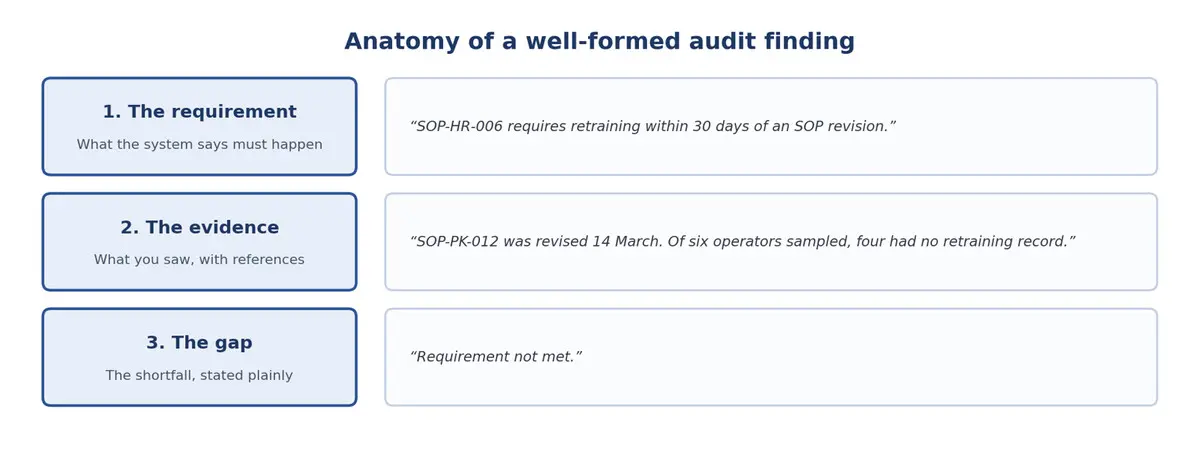
State the requirement first, because it establishes that you are measuring against something agreed, not against personal preference. State the evidence second, with references, because it lets anyone verify the finding without repeating the audit. State the gap last, because it should be self-evident once the first two are on the page.
Compare the two versions below. Both describe the same situation.
| Weak wording | Well-formed finding |
|---|---|
| “Training records are not well maintained in the packaging area.” | “SOP-HR-006 requires retraining within 30 days of an SOP revision. SOP-PK-012 was revised on 14 March. Of six packaging operators sampled, four had no retraining record as of the audit date. Requirement not met.” |
The first invites an argument. The second ends one. The area manager may not like it, but there is nothing in it to dispute, and it points directly at what has to be fixed.
Where Auditors Look, and What Proves It
Every GMP area has a small number of records that reveal whether the control is real. Experienced auditors go to those first.
| Area | The question behind the audit | Records that answer it |
|---|---|---|
| Documentation | Do the procedures at the workstation match the controlled versions? | Document register, workstation copies, revision history |
| Batch production | Were records completed as the work happened, not afterwards? | Batch records, entry times, signature patterns, line clearance logs |
| Laboratory | Are out-of-specification results investigated rather than retested away? | OOS logs, investigation reports, analyst worksheets, instrument audit trails |
| Equipment | Is anything in use past its calibration or maintenance due date? | Calibration certificates, maintenance schedule, equipment status labels |
| Materials | Can a released batch be traced back to every component lot? | Receipt records, status labels, release documentation, storage logs |
| Change control | Were process or equipment changes assessed before they happened? | Change requests, approvals, linked validation and training records |
| Data integrity | Can records be altered without a trace? | System access lists, audit trails, spreadsheet controls, shared-login checks |
| CAPA | Is closure based on evidence or on a signature? | CAPA files, root-cause records, effectiveness-check evidence |
Participants learn to move between these quickly. They also learn to recognize the patterns that signal a deeper problem — signatures in identical handwriting, entry times that cluster suspiciously, and logbooks with no corrections in two years.
Running the Audit
Plan and prepare
Define scope and criteria. Name the process, the lines, the time period of records, and what you are auditing against. An audit without defined criteria produces opinions.
Prepare properly. Read the SOPs, the last report and the open CAPAs before you walk in. Draft a checklist that names sources and samples rather than asking yes/no questions.
Open briefly. Confirm scope, timing and who will be available. Five minutes, not thirty.
On the floor
Work the floor and the records together. Observe the operation, review the records that should describe it, and talk to the people performing it. Any one of those alone can be misleading; together they are hard to fake.
Follow the thread. When something looks wrong, widen the sample immediately. One lapse is an incident. A pattern is a finding about the system.
Close out and follow up
Classify before you close. Draft and grade findings ahead of the closing meeting so the discussion is about facts, not about wording.
Report clearly. Scope, criteria, records sampled, findings with classification, agreed dates — written so a reader who was not there understands exactly what was seen.
Verify the fix. Review the root cause, judge whether the action addresses it, and go back later to confirm it held. This step is where internal audit either creates improvement or becomes paperwork.
Who Should Take cGMP Internal Auditor Training
The training is built for people who will conduct internal audits, and for those who will be audited and want to understand what is coming.
| Role | Typical reason for attending |
|---|---|
| QA specialists and managers | Own the internal audit program and the CAPA system |
| QC analysts and lab supervisors | Laboratory records and OOS handling attract close audit attention |
| Manufacturing supervisors | Translate findings into line-level corrections that stick |
| Validation and engineering | Calibration, qualification and change control are core audit targets |
| Warehouse and distribution | Receipt, quarantine, storage conditions and traceability |
| Regulatory and compliance staff | Add a working audit method to existing requirements knowledge |
| Contract manufacturers and packagers | Prepare for frequent client audits and audit their own suppliers |
| Quality system owners | Design the audit program and feed management review |
No previous audit experience is assumed. People who already work inside a cGMP system pick it up fastest. For anyone new to manufacturing quality, an online cGMP foundation course is a more comfortable entry point, and broader GMP training in the USA covers manufacturing-quality fundamentals rather than audit technique.
What cGMP Internal Auditor Training Prepares You to Do
- Scope an audit that is finishable and still worth doing
- Build a checklist that names sources, samples and comparisons
- Sample records in a way that represents the period rather than the pile
- Distinguish a document that exists from a control that works
- Recognize data-integrity weaknesses in paper and electronic records
- Interview operators without leading them toward the answer
- Grade findings consistently against a defined scale
- Write findings in requirement–evidence–gap form
- Assess whether a corrective action addressed the root cause
- Produce a report that management review can actually use

What the Organization Gets
A trained internal audit team changes three things. External audits stop producing surprises, because the site already knows its weak points. Documentation discipline improves, because people behave differently when they know records are read. And CAPA becomes a real loop rather than a filing system, because someone verifies effectiveness instead of accepting a closure signature.
There is a supply-chain benefit as well. The same method used to audit your own site works for auditing contract manufacturers, packagers and material suppliers — which matters when your customers hold you responsible for their performance.
For manufacturers also pursuing independent assessment of the facility itself, the cGMP certification in the USA page covers that route, and the IAS guide on how to get GMP certification explains how the two fit together.
Internal Auditor Training Is Not Certification
| cGMP Internal Auditor Training | cGMP Certification | |
|---|---|---|
| Who or what it applies to | Individual employees | The organization and its facility |
| Delivered or performed by | A training provider; your staff then audit internally | An independent certification body |
| Audit type | First-party | Third-party |
| What you end up with | Trained auditors and a training record | A certificate for a defined scope |
| Timing | Audits run continuously to the internal program | Initial assessment, then surveillance and recertification |
| Primary purpose | Find and fix issues internally | Demonstrate control to customers and markets |
Neither replaces the other. A certified quality system is expected to audit itself, so the training supports certification. Completing a course does not certify a company. Holding a certificate does not remove the need for internal audits.
cGMP Internal Auditor Training in the USA: Course Details and Delivery
Duration, delivery format and fees for cGMP internal auditor training in the USA are confirmed at booking rather than fixed in advance, because the schedule is built around your shift pattern. Everyone finishing this cGMP internal auditor course receives a certificate of completion recording the syllabus and the date. Your training file needs it when an assessor checks auditor competence.
Objective, coverage and outcomes
Objective. Equip participants to plan, conduct, report and follow up internal audits of cGMP and GMP quality systems.
Coverage. GMP and cGMP fundamentals, audit criteria and scope, audit planning and checklist development. Record review and sampling, observation and interviewing, objective evidence, nonconformity classification. Finding and report writing, root-cause review, corrective-action effectiveness verification, auditor independence and conduct.
Outcomes. Participants should be able to prepare an audit plan and checklist, conduct an internal audit, gather referenced evidence, raise and word nonconformities, produce an audit report, and evaluate corrective actions.
Delivery formats
Classroom, live virtual, self-paced online, and in-house delivery for a company’s own team. Shift patterns decide this more often than budget does: the online cGMP internal auditor training lets people work through the material between production commitments, and virtual cGMP training preserves the live exercises for a team spread across locations. A fuller syllabus breakdown sits on the IAS GMP internal auditor training page, and the wider internal auditor training in the USA range covers other standards.
In-house sessions have one clear advantage: the group leaves holding drafted checklists for the areas they are about to audit, so the first real audit happens within weeks rather than months. Share your facility location, product categories and headcount and we will propose a format and dates.
One point of honesty before you commit to any provider. IAS trains auditors and certifies management systems. It does not approve products, register facilities, or grant regulatory clearance of any kind — those sit with the regulators, and a training certificate has no bearing on them.
Book a place or request in-house dates on 1 (888) 493-0916 — contact us · download the nomination form · download the course brochure
Frequently Asked Questions
What does cGMP internal auditor training actually teach?
It teaches a method, applied to your own facility. Participants learn to define audit scope and criteria and to prepare a checklist that names sources and samples. They review records, observe operations, interview personnel without leading them, and collect referenced objective evidence. They also classify and word nonconformities, write a usable audit report, and verify that corrective actions were effective rather than simply closed.
How is an internal audit different from an external audit?
An internal audit is first-party — your own trained staff auditing areas they do not work in, as often as the audit program requires. An external audit is third-party, performed by an independent body on a defined cycle, and results in a certificate or an external findings report. Internal audits exist to find and fix problems; external audits exist to demonstrate control to others.
What does “objective evidence” actually mean?
Information that can be verified by someone else. In practice that means references: document numbers and revisions, batch or lot numbers, equipment IDs, dates, the specific records sampled, and what was observed. “Records appeared incomplete” is not objective evidence. “Four of six batch records sampled for March lacked the line-clearance signature required by SOP-PR-021” is.
Does the course cover data integrity?
Yes — a data integrity audit is covered as it applies to your own records. Participants learn what to look for in both paper and electronic records. That includes audit trails, access controls, shared logins, uncontrolled spreadsheets, retrospective entries and correction practices. They also learn to word a data-integrity finding factually rather than as an accusation.
Can someone with no auditing background take this course?
Yes. The training assumes no prior audit experience and begins with GMP and cGMP fundamentals before moving into technique. Participants who already work within a manufacturing quality system apply it fastest. Those entirely new to the field usually benefit from a foundation course first, then the auditor training.
How do we decide which areas to audit and how often?
Most sites run a risk-based program. Areas with the greatest impact on product quality — production, documentation, laboratory, materials — are audited most frequently. Support functions are audited less often. Any area with recent findings gets revisited sooner. The program is reviewed annually using what the previous year’s audits actually found.
What is the most common mistake new internal auditors make?
Confirming that documents exist instead of testing whether controls work. A complete file proves someone filled in a form; it does not prove the activity happened as described. The training pushes participants to test the control itself — by watching the operation, comparing it against the record, and asking the person performing it to explain what they do.
Will this help us prepare for customer audits?
Directly. Customer auditors look at the same areas and ask the same kinds of questions. A site that has been audited internally against the same criteria knows where its weaknesses are, has evidence ready, and can answer from records rather than memory. It also makes the difference between a customer finding something new and a customer finding something you already had an action plan for.
Do participants get a certificate?
Participants who complete the course and its assessment receive a training record confirming they have been trained to conduct internal audits. That record belongs in their personnel training file. It is a record of individual training and is not a certification of the company or its facility.