
HACCP Training
HACCP Training in the USA
Build the food safety skills American employers actively hunt for, and turn HACCP knowledge into a credential that moves your career forward.
If you work anywhere in the US food supply chain, HACCP is the language your employers, your auditors, and the FDA all speak. HACCP training from IAS gives you a clear, practical command of that language so you can identify hazards, build preventive controls, and protect both consumers and your organization. Whether you are stepping into food safety for the first time or sharpening an existing role, this program turns the Hazard Analysis and Critical Control Point method into skills you can apply on Monday morning.
You learn in plain English, with logical steps and real food industry examples, then walk away ready to support a compliant, audit-ready food safety system. The result is a stronger resume, more confidence on the production floor, and measurable value for your employer.
Ready to get started? Enroll or contact IAS today to reserve your place and ask any questions about delivery formats, schedules, or group bookings.
What Is HACCP Training?
HACCP training is a structured professional learning program that teaches you how food safety risks are identified, assessed, and controlled at every stage of food production. It is built on the Hazard Analysis and Critical Control Point methodology, an internationally recognized, preventive approach to food safety. Instead of reacting to problems after they appear, HACCP equips you to anticipate and stop them before they reach the consumer.
This program is designed for learners with little or no background in food safety, so concepts are explained using simple language, logical steps, and practical examples drawn from real operations. By the time you finish, you understand how preventive food safety systems are designed and why they matter to regulators, customers, and your own career.
HACCP also forms the backbone of recognized food safety schemes, which is why it connects naturally to formal HACCP certification for organizations that want third-party validation of their systems.
Why Take HACCP Training? Key Benefits?
HACCP training delivers benefits that work on two levels at once: your personal career and the organization you support. For you as an individual, it builds in-demand, transferable food safety skills that hiring managers across the US food industry actively look for. Employers consistently prefer candidates who understand preventive food safety systems and compliance obligations, so completing this training strengthens your resume and demonstrates a genuine commitment to food safety excellence.
For your organization, trained personnel mean fewer food safety incidents, more consistent product quality, and smoother audits. The headline advantages include:
- Stronger employability and faster access to food safety, QA, and compliance roles
- Practical ability to identify hazards and build effective preventive controls
- Alignment with FDA 21 CFR Part 117, FSMA requirements, and globally accepted standards
- Reduced risk of recalls, contamination events, and costly non-compliance
- Improved confidence when responding to deviations on the production floor
- A foundation for career growth into leadership and food safety management roles
In short, HACCP training pays you back in both job security and professional credibility while helping your employer protect its brand and customers.
Who Should Attend HACCP Training?
HACCP training suits a wide range of food industry professionals who help maintain and improve food safety systems. If your work touches food in any way, this course is built for you.
- Food safety managers who design, implement, and maintain food safety systems
- Quality assurance personnel who monitor processes, verify controls, and keep documentation accurate
- Production supervisors and operational staff who manage critical control points day to day
- Food handlers who need to follow safe practices and respond correctly to deviations
- HACCP team leaders responsible for implementation and certification activities
- Beginners and career changers entering food safety for the first time
Because the structure moves step by step, experienced professionals can deepen their knowledge while newcomers build confidence from the ground up.
What You Will Learn?
HACCP training teaches how food safety systems work in real environments such as manufacturing plants, processing units, catering services, and storage facilities. You learn to recognize hazards that could compromise food safety and to apply preventive controls effectively.
Through the program you will learn how to:
- Identify biological, chemical, and physical hazards across the process
- Establish critical control points within food operations
- Set and monitor critical limits, then take corrective action when limits are breached
- Maintain records and verify that the system performs as intended
- Draft and implement a functional HACCP plan aligned with regulatory and industry requirements
This practical focus ensures the knowledge applies directly to your daily food operations rather than staying locked in theory.
The 7 Principles of HACCP
The foundation of HACCP training is built around seven internationally recognized principles that guide the development of an effective food safety management system. Mastering these principles is a core outcome of the course.
- Conduct a hazard analysis to identify potential food safety risks
- Determine the critical control points (CCPs) in the process
- Establish critical limits for each CCP
- Set up monitoring procedures to track the CCPs
- Define corrective actions for deviations
- Establish verification procedures to confirm effectiveness
- Maintain documentation and record-keeping systems
Understanding how these seven principles connect lets you manage food safety proactively rather than scrambling after a problem occurs.
Course Agenda and Modules
The HACCP curriculum is designed to build knowledge in a clear, logical sequence so you understand both the theory and how to apply it. The modules introduce the key concepts behind every effective food safety system.
- History and Fundamentals of HACCP: the origins of HACCP and the basic principles of preventing food safety hazards
- Food Safety Hazards and Contamination Sources: identifying biological, chemical, and physical hazards that can contaminate food
- Risk Assessment and Control Methods: assessing risks in food processes and putting controls in place
- Prerequisite Programs and Flow Diagrams: understanding supporting programs and visualizing processes to manage hazards
- Verification, Validation, and Sampling Techniques: confirming the HACCP system works and monitoring safety through sampling
By the end of these modules, you are capable of drafting and implementing a functional HACCP plan that stands up to regulatory and customer scrutiny.
Course Format and Duration
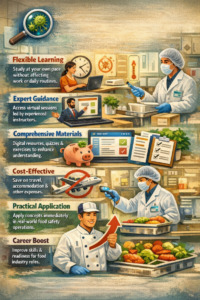
IAS offers flexible learning options so HACCP concepts stay easy to grasp no matter how you prefer to study. HACCP online training is delivered in two formats.
Virtual Instructor-Led Learning
Live virtual sessions let you learn directly from experienced instructors. Concepts are explained clearly, your questions are answered in real time, and practical examples help you connect food safety principles to your own workplace quickly. This format suits learners who value interaction and structured guidance.
Self-Learning Mode
The self-paced format gives you access to digital materials, quizzes, and assessments for an extended period. It is ideal if you want to learn around a busy work schedule and build your confidence gradually, without sacrificing the depth or quality of the content.
Both formats deliver the same rigorous learning outcomes, so you can choose the option that fits your time, role, and learning style.
Certification You Receive
On successful completion of HACCP training, you receive recognition that demonstrates your competence in preventive food safety. This credential signals to employers that you understand the HACCP methodology, the seven principles, and how to apply preventive controls in line with FDA and FSMA expectations.
For many professionals, HACCP training is the first formal step toward becoming a recognized food safety specialist. It strengthens your professional profile, supports internal promotions, and positions you for roles that require demonstrable food safety knowledge.
Career Opportunities After HACCP Training
HACCP training opens doors to careers in food safety, quality assurance, and compliance across the food industry. You could work as a food safety manager, production supervisor, QA executive, or HACCP team member in manufacturing units, processing plants, catering services, retail chains, and export-oriented food businesses.
Beyond your first role, the credential supports long-term career growth, improves employability, and creates a pathway toward leadership positions in food safety management. In a US market where compliance is non-negotiable, that combination of skills and credibility is a genuine differentiator.
Want to map this to your specific goals? Contact IAS and we will help you choose the right format and start date.
How to Enroll in HACCP Training?
Enrolling is simple. Choose your preferred format, confirm a start date, and reserve your place. You can review upcoming dates on the HACCP training schedule and then secure your slot.
- Review the available delivery formats and pick the one that suits your schedule
- Check upcoming dates on the training schedule
- Contact IAS to confirm your place and complete enrolment
- Receive joining details and course materials, then begin building your food safety skills
Have questions first? Reach out to IAS today for guidance on individual or group enrolment.
Why Train with IAS in the USA?
IAS delivers industry-focused HACCP training supported by well-structured learning materials, practical exercises, and real-world examples. The approach emphasizes understanding and application rather than memorization, so you leave able to do the work, not just pass a quiz.
With expert guidance and interactive learning methods, IAS makes sure every participant completes the program ready to meet modern food safety challenges. Backed by a strong certification heritage and US-based support, IAS is a dependable training partner for individuals and organizations across the country.
Enroll in HACCP Training Today
Do not let a missing credential hold back your food safety career or your organization’s compliance. Take the next step now: contact IAS to enroll in HACCP training and start turning food safety knowledge into real career momentum.
For more information on HACCP online training, please contact us today or visit our HACCP training frequently asked questions page!
E-Mail: enquiry@iascertification.com
Check out this blog to learn more about ISO Certification!
Other Pages : GMP Training
Frequently Asked Questions
Do I need prior experience to take HACCP training?
No. HACCP training is designed for learners with little or no background in food safety. Concepts are explained in plain language with logical steps and practical examples, so beginners and experienced professionals alike can follow along and benefit.
Is HACCP training available online in the USA?
Yes. IAS offers HACCP online training in two formats: virtual instructor-led sessions delivered live by experienced trainers, and a self-paced self-learning mode with digital materials, quizzes, and assessments. You can choose whichever fits your schedule.
What are the 7 principles of HACCP covered in the course?
The course covers all seven principles: conducting a hazard analysis, determining critical control points, establishing critical limits, setting monitoring procedures, defining corrective actions, establishing verification procedures, and maintaining documentation and records.
Does HACCP training help with FDA and FSMA compliance?
Yes. The training supports alignment with FDA 21 CFR Part 117, FSMA requirements, and internationally accepted food safety standards, helping you and your organization meet regulatory expectations with confidence.
Who should attend HACCP training?
It suits food safety managers, quality assurance personnel, production supervisors, food handlers, HACCP team leaders, and beginners entering food safety. Anyone whose work touches food production, processing, catering, or storage will benefit.
How do I enrol in HACCP training with IAS?
Choose your preferred format, check the training schedule for dates, and contact IAS to confirm your place. Get in touch with IAS to complete your enrolment or ask about group bookings.