
Kosher Certification in USA
A customer asked for it. Maybe a distributor, maybe a national retail account, maybe a co-manufacturing client who needs your line to match their own program. You make the product, so the request for kosher certification lands on your desk. This page explains what a kosher certification assessment looks at, what it will ask of your plant, and where the work usually gets stuck.
Kosher status follows two things: what goes into the product, and what the product touches. Ingredients and equipment. Almost every difficulty in a first kosher certification assessment traces back to one of those two. Shared production lines are the most common complication of all, and they are worth understanding before you apply.
Need kosher certification for a US buyer? IAS assesses food manufacturers, packers and ingredient suppliers against kosher scheme requirements. Talk to our team about your products and your lines.
What a kosher certification assessment actually examines
A kosher certification assessment is an evidence exercise. The audit team is checking whether your plant can show, on paper and on the floor, that the product it makes matches what the scheme requires.
That breaks into a few practical questions. Where does each raw material come from? What status does that material carry, and who says so? What equipment does the material pass through between goods-in and pallet? What else runs on that equipment? How is the changeover handled, and how do you know it worked?
Those are operational questions, not religious ones. A certification body assesses and reports against defined requirements. Rulings on religious law are not made by auditors, and are not made on this page. Such questions belong with the appropriate religious authority.
Ingredients: the part that takes the longest
This step is routinely underestimated. You will need a complete bill of materials for every product in scope, and then you will need the layer beneath it.
The layer beneath is where the work is. A flavor system is not one ingredient. It has a carrier, a solvent, and often several components of its own. An enzyme has a growth medium. A vitamin premix has an anticaking agent. A colorant has a diluent. None of these appear on a consumer label, and all of them are in scope.
The usual sticking point is the ingredient nobody thinks of as an ingredient:
- Pan release agents and mold lubricants
- Anti-foam used in cook kettles or fermenters
- Filter aids, fining agents and clarifiers
- Processing aids that are removed later in the process
- Food-grade lubricants with incidental product contact
- Rework and carry-over streams from earlier runs
- Steam additives and boiler treatment where steam contacts product
Build your list from the process, not from the label. Walk the line and write down everything that touches product, including things that are consumed or removed. Then chase documentation for each one from the supplier that made it, not from the broker that sold it. Where an ingredient carries a certificate of its own, the product certification procedure in USA page explains how that kind of assessment is run and what its documents actually say.
Shared lines, and why they complicate everything
If a line runs only products in scope, the equipment question is short. Very few plants are in that position. Most run a mixed schedule, and that is where the assessment gets detailed.
The scheme cares about what the equipment carried before, and whether anything carried over. So you will be asked about run sequencing, about cleaning between products, and about how you demonstrate the cleaning worked. A documented cleanout with a verification step is a different thing from “we run water through it.”
The table below sets out common plant situations and what each one usually means for the evidence you need to assemble. It is a starting point for scoping your own application, not a ruling on any individual case.
| Your situation | What it usually means | Evidence you should expect to produce |
|---|---|---|
| Dedicated line, dedicated equipment, no shared parts | Simplest scope. Focus stays on ingredients | Equipment list, line diagram, proof of dedication |
| Shared line, full changeover between product families | Workable, but the changeover becomes the control point | Written changeover procedure, cleaning records, verification result |
| Shared line, sequencing used instead of full cleaning | Depends heavily on what runs before. Expect close questions | Production schedule rules, sequencing logic, change-control records |
| Shared CIP loop serving several lines | Loop design and routing matter as much as chemistry | P&ID or loop schematic, valve and routing controls, CIP records |
| Open plant with airborne carryover, such as a bakery | Segregation in space or time usually needed | Air handling notes, physical separation, scheduling controls |
| Third-party co-manufacturer makes part of the product | Their site comes into the picture, not just yours | Contract terms, their status documents, your oversight records |
| Storage and transport shared with other goods | Often overlooked. Usually manageable with controls | Warehouse layout, segregation rules, sealing and transport records |
Work through that honestly before you apply. A scope built on an optimistic answer gets corrected during the audit, and that costs more time than getting it right now. Cleaning validation and changeover discipline are the same ground covered in GMP training in USA, so teams that have been through it tend to have the records already.
Who IAS is, and who accredits IAS
IAS is a certification body, which is what the phrase kosher certification company means in practice: IAS employs or contracts audit teams, assesses client organizations against defined requirements, and makes certification decisions based on what those teams report.
Certification bodies are themselves subject to oversight. That oversight is called accreditation, and it is carried out by a separate body. IAS is accredited by UQAS. UQAS assesses IAS against the requirements that apply to bodies performing certification: impartiality and freedom from commercial pressure, auditor competence and qualification, separation between the people who audit and the people who decide, control of records, and a working complaints and appeals route.
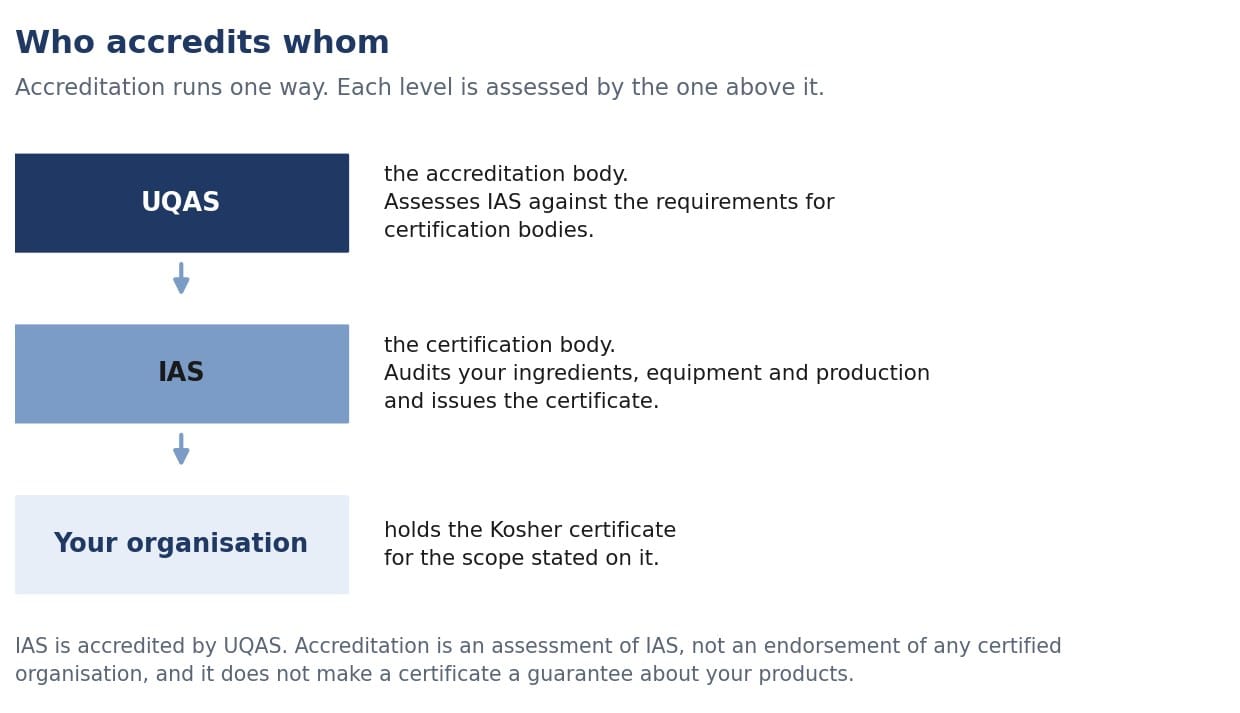
One point deserves to be stated plainly, because it is often misread. Accreditation is an assessment of IAS. It is not a recommendation of any certified producer. When a buyer asks who accredits your certification body, the honest answer describes oversight of the certifier, and nothing more.
If accreditation as a concept is new to you, the certification process in USA page sets out how the pieces fit together, and the ISO audit procedure in USA page explains how audit stages are structured across schemes.
The kosher certification process from application to certificate
The sequence is predictable. Knowing it helps you plan around production schedules instead of against them.
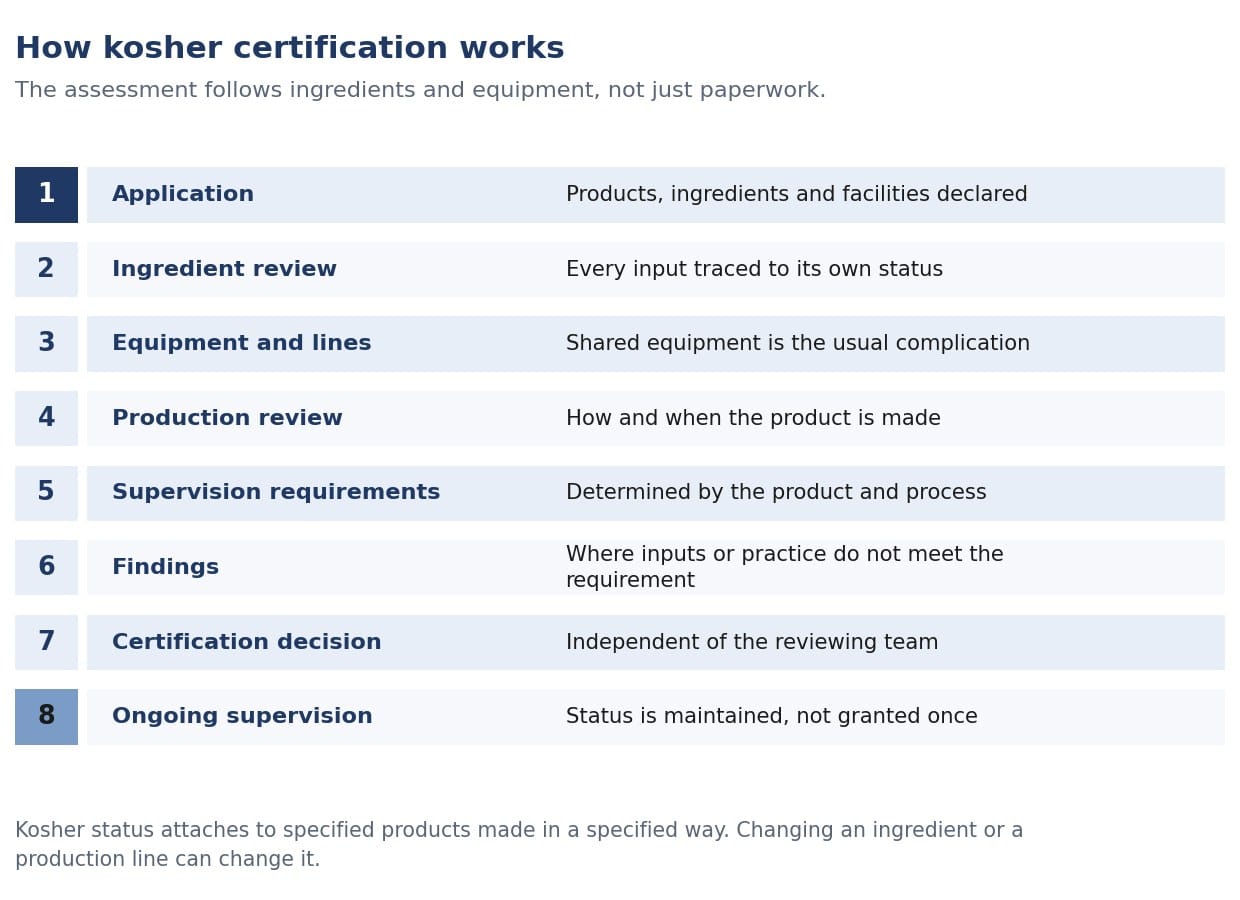
Application and scope. You list products, sites, lines and any co-manufacturers. Scope errors here cause most of the trouble later.
Document and ingredient review. Bills of materials, supplier documentation, process flows, cleaning procedures. This is off-site work and it is where gaps surface first.
Site assessment. The audit team walks the process, checks equipment against your diagrams, reviews records at the point of use, and talks to operators. Expect questions on the floor, not just in the conference room.
Findings and response. Anything that does not match is written up. You respond with correction and, where needed, root cause analysis.
Certification decision. Made by IAS, separately from the audit team. This separation is one of the things accreditation exists to verify.
Surveillance. Continued assessment at planned intervals confirms the certificate still reflects reality.
That shape will look familiar if you hold other certificates. The same stages run across the ISO certification in USA schemes IAS operates, which is why a plant with one certificate usually finds the second easier to plan.
✓ Assessment against defined scheme requirements | ✓ IAS is accredited by UQAS | ✓ Audits by qualified food-sector assessors | ✓ Certification decisions made independently of the audit team
Who does what during the process
Confusion over roles wastes time. The split below is the normal arrangement.
| Task | Your organization | IAS audit and certification team |
|---|---|---|
| Define which products and sites to include | Proposes scope | Reviews scope for completeness |
| Assemble ingredient and supplier documentation | Owns and produces it | Reviews it against requirements |
| Obtain status documents from suppliers | Owns this entirely | Checks currency and coverage |
| Map process flow and equipment | Owns and maintains | Verifies against the physical plant |
| Write cleaning and changeover procedures | Owns and validates | Assesses adequacy and records |
| Train operators on the controls | Owns delivery | Samples understanding on site |
| Raise and record findings | Responds to them | Raises and verifies closure |
| Decide whether to certify | No role | Decides, independently of the auditors |
| Keep records between assessments | Owns | Samples at surveillance |
Notice the last row of the third column. Certification bodies do not consult on the fixes they later assess. If you need help building the system itself, that help comes from somewhere other than the body that will audit you. Training is a separate matter from consultancy, and open courses are listed on the IAS training schedule.
What the certificate covers, and what it leaves to you
This matters more than any other section, because certificates get quoted in places they were never meant to reach.
A certificate records that IAS assessed a defined scope against defined requirements at a point in time, and that the evidence seen supported the decision. It covers the products, sites and lines named on it. It does not cover anything else you make.
It is not a guarantee. An audit examines a sample of evidence on the days it is conducted. It cannot confirm every batch made before or after. Day-to-day conformity remains the responsibility of the organization holding the certificate. That is true of every certification scheme, and it is worth saying out loud to any buyer who reads a certificate as a warranty.
| What the certificate does | What the certificate does not do |
|---|---|
| Names a specific scope of products, sites and lines | Extend to products or sites not listed |
| Records that a kosher certification assessment took place against stated requirements | Certify every batch produced |
| Shows the evidence sampled supported the decision | Guarantee future conformity |
| Gives buyers a documented basis for their own checks | Replace the buyer’s own due diligence |
| Carries a validity period with surveillance built in | Remain valid if the scope changes and you do not tell us |
| Reflects oversight of IAS by UQAS | Endorse your organization by virtue of that oversight |
| Sits within a defined complaints and appeals route | Settle questions of religious law |
Logo and claim use is a related trap. Marketing teams stretch certificate wording in ways the certificate does not support. The guideline for usage of logos in USA page sets out what is and is not acceptable.
How this fits with your other food safety systems
Kosher work is not a food safety system, and it does not replace one. But it leans on the same records, so plants with mature systems usually move faster.
Supplier approval, traceability, allergen segregation and sanitation verification all produce evidence that an assessment can use. Plants that also deal with FDA registration and listing in the USA will recognise the same record-keeping discipline. If you already run HACCP, the hazard analysis and its verification records will feel familiar. Sites certified to ISO 22000 or FSSC 22000 already hold most of the documentation structure. BRC certification and cGMP certification cover much of the same hygiene ground.
The overlap is real but partial. Allergen changeover validation is a close cousin of what a shared-line control needs, yet the two ask different questions of the same cleaning step. Treat an existing system as a foundation, not as an answer.
The people who usually carry this work are the ones who already audit internally. ISO 22000 internal auditor training and cGMP internal auditor training both build the habit of testing a record against the floor, which is the habit this assessment rewards.
Where first kosher certification assessments usually stall
Patterns repeat. These are the ones worth checking before a kosher audit begins.
- Sub-ingredient blind spots. A compound ingredient documented at the top level only.
- Documents from the wrong party. A distributor letter where the manufacturer’s own documentation is needed.
- Expired paperwork. Supplier status documents have validity dates, and quality teams forget to track them.
- Undocumented formula changes. Procurement swapped a supplier for a shortage and nobody told quality.
- Cleaning with no verification. A procedure exists. Evidence that it worked does not.
- Process flow that does not match the floor. A diagram drawn two rebuilds ago.
- Rework nobody mapped. Trim, overs and returned product looping back into a later batch.
- Co-manufacturers treated as out of scope. If they make it, they are in it.
Most of these are administrative rather than technical. They are also cheaper to fix in advance than after a finding is written. If the gap is that nobody in the plant reads an audit trail the way an auditor does, foundation training is a reasonable place to start.
Keeping the certificate current
A certificate reflects your plant as it was assessed. Plants change. The obligation is to tell IAS when something material moves.
Tell us about new products added to a certified line. Tell us about reformulations, even small ones. Tell us about a new supplier for an existing ingredient. Tell us about a new line, a new site, or a change to an existing line’s equipment. Tell us if you start using a co-manufacturer.
Build this into change control. The most common cause of a scope problem is not concealment. It is a change request that passed through R&D and procurement without anyone asking whether certification was affected. Add a checkbox to the form. Plants running a quality management system to ISO 9001 already have a change-control route to hang that checkbox on.
Legal position
This page takes no position on the law of any country, state or municipality. It does not describe any labeling obligation, any registration requirement, or any consequence of holding or not holding a certificate. Rules on food labeling and product claims differ by jurisdiction and change over time.
Legal duties that apply to your business are for your own advisers to identify. Requirements imposed by a specific customer are for you and that customer to agree. Nothing here should be read as legal advice, and nothing here should be read as a statement about religious law.
Getting started with kosher certification at IAS
Kosher certification begins with an honest scope. List the products you actually need certified, the lines they run on, and everything else those lines run. Pull the bills of materials down to sub-ingredient level. Identify which supplier documents you already hold and which you need to chase.
Then talk to us. We would rather have a scoping conversation early than correct a scope during an audit. IAS also works across system certification, product certification and training in the food sector, so a single conversation can cover more than one requirement your buyer has raised. Outside the states where our own assessors are based, work is arranged through associate partners in USA.
Ready to scope your kosher certification application? Send us your product list and your line layout, and we will tell you what the assessment will need. Contact IAS or read more about us.
Frequently asked questions
Does a kosher certificate cover my whole factory?
No. It covers the scope written on it: named products, named sites, named lines. Anything outside that list is not covered, even if it is made in the same building.
Do I need every ingredient documented, including processing aids?
Yes. Anything that contacts product is in scope, including materials removed later in the process. Build the list from your process flow rather than from the consumer label.
Can a shared line get kosher certification?
Shared lines are assessed on their controls. Sequencing, cleaning and verification all matter. Whether a particular arrangement is acceptable depends on the scheme requirements applied to your specific case, which is why scoping conversations happen early.
Who accredits IAS for kosher certification?
IAS is accredited by UQAS. UQAS assesses IAS as a certification body: impartiality, competence, decision-making separation, records and appeals. That accreditation is an assessment of IAS and is not an endorsement of any company IAS certifies.
Does the certificate prove every batch is compliant?
No. An assessment samples evidence at a point in time. It is not a guarantee of future or past batches. Daily conformity is your responsibility as the certificate holder.
Will IAS help us fix the gaps found during the audit?
No. The body that assesses you cannot also consult on the system it assesses. That separation is part of what accreditation checks. You are free to use an independent consultant for the build.
What happens if we change a supplier mid-cycle?
Tell us. A supplier change for a certified ingredient is a change to the basis of the certificate. Handled early it is routine. Discovered at surveillance it is a finding.
Does having HACCP or FSSC 22000 make kosher certification easier?
It usually does. You will already have supplier approval, traceability and sanitation records in a usable form. The schemes ask different questions of the same evidence, so existing certification shortens the work without replacing it.
Can a co-manufacturer’s site be excluded?
Not if they make product within your scope. Their process is part of your product’s journey, so their status and your oversight of them both come into the assessment.
How do we use the certificate in marketing?
Within the limits of the scope and the logo rules. Do not extend a claim to products the certificate does not name. The logo usage guideline sets the boundaries, and the FAQ page answers more general certification questions.
Does IAS decide what is kosher?
No. IAS assesses and certifies against the requirements of the scheme. Determinations of religious law rest with the appropriate religious authority, not with a certification body or its auditors.
Where can I learn more about food-sector auditing?
Our blog on auditing food fraud and authenticity covers supply chain evidence in depth. For audit skills, see HACCP training and ISO 22000 lead auditor training. The wider IAS blog carries more on food-sector evidence and audit practice, and the IAS home page lists the full range of services.